
I Can’t Draw. Can I Still Keep an Art Journal?

Yes, you can. An art journal never asks whether your drawing looks like the thing you drew. It asks whether the page reflects what you feel right now, and a color you love, an image torn from a magazine, a simple line and a few words can do that. Drawing is one way onto the page, and you may never need it.
I am Rakefet Hadar, an art therapist, an author, and the founder of the school that trains SoulPages facilitators to guide creative work in a visual journal. Almost every woman I have met along the way began by telling me, “I can’t draw.” Most of the answers you will find online are kind. They tell you that anyone can do this, and then they hand you stencils and stickers. I would like to give you the reason behind the reassurance, and a whole first page that has no drawing in it.
Can you keep an art journal if you can’t draw?
Yes. An art journal, or visual journal, is a book you fill with color, images, line and words, to make room for what is happening inside you. You open it when you need it and close it when you are done. Nobody grades it, and it does not have to look like anything.
SoulPages is a method of working in a visual journal, built on seven elements: intention, the magic of chance, background, images, color, line and text. None of the seven requires you to know how to draw. Images, for example, can be drawn or cut out and glued, and in my method a glued image counts exactly as much as a drawn one.
Why doesn’t drawing skill matter in a visual journal?
There are three reasons.
- The journal asks a different question. A drawing class checks whether the apple on the paper looks like the apple on the table. In your journal, you check one thing: whether the page feels true to you today. A big red smear of paint can do that better than an accurate apple.
- Most of what you do is choose. Which color, which image, where it goes on the page. In the step I call the magic of chance, you pick what you are drawn to without knowing why yet, and there is no wrong way to make that kind of choice.
- Your line is a signature. In SoulPages, your line is as personal as your handwriting. Nobody wonders whether she has a talent for signing her name.
What is the difference between a drawing class and a visual journal?
Both are worth your time. Here is what each one gives you.
| A drawing class | A visual journal | |
|---|---|---|
| What you learn | Technique: proportion, light and shadow, depth | Giving color and shape to what you feel |
| Where you start | Looking closely at an object or a model | An intention, and a background of color |
| What counts as success | A drawing that looks like what you meant to draw | A page that reflects what you feel right now |
| Who sees it | The teacher and the class | You, and anyone you choose to show it to |
| What you bring | A wish to practice and improve | A page, some paint, a few images and a few minutes |
If you want to learn to draw, take a drawing class, and enjoy it. If you want a place of your own on the page, you can begin today, with the hands you have.
What does a first page with no drawing look like?
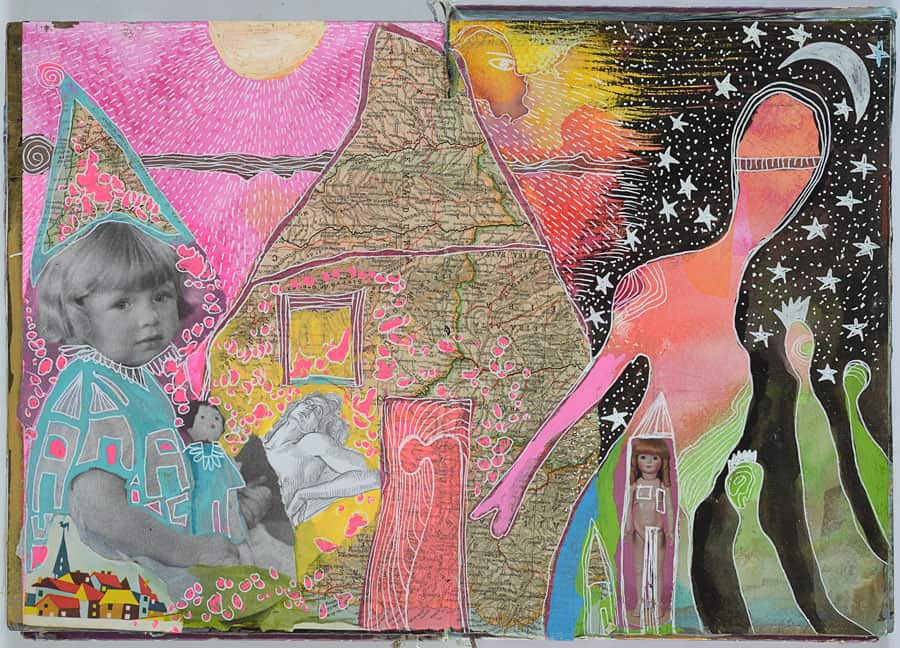
You walk through the seven elements, one after the other. Gather a journal or a sheet of thick paper, watercolor, a wide brush, an old magazine, glue and a black pen. Here is the whole page, step by step:
- Intention. Choose one word for what you would like to find on the page today: quiet, joy, strength.
- The magic of chance. Leaf through the magazine and pull out whatever you are drawn to, before you understand why.
- Background. Wet the wide brush and cover the whole page with one color. This is the first layer on the page, and you cannot get it wrong.
- Images. Cut or tear out what you chose, and glue it onto the background.
- Color. Add color around the images, wherever the page still looks empty.
- Line. Take the pen and outline one image, or fill a corner with dots and short dashes. Your hand already knows how.
- Text. Write a few words, or a single one, and add the date.
When you finish, look at the page for a minute before you close the journal. It holds an intention, color, images, line and words, and you didn’t draw a thing. If you want a next page, the Bridges to Myself protocol takes you through one step by step.
Do you need stencils, stamps or special supplies?
No. Stencils and stamps are fine if you enjoy them, but they are sold to beginners as a way around drawing. You don’t need a way around it. A magazine gives you more images than you will ever use, a pen gives you line, and a single color gives you a background.
Start with what you already have at home. You can add supplies later, once you know what you keep reaching for.
What do you do when a voice inside says “this is ugly”?
It will come, almost every time. There is no point in arguing with it. Keep going, and the voice gets quieter. Here are four ways to do that:
- Leave the page in the journal. A page you dislike today can become the background of tomorrow’s page.
- Add a layer. Paint over paint, paper over paper. A visual journal is made in layers, and anything you dislike can be covered.
- Go back to choosing. Open the magazine again and pick one more image. You cannot choose an image badly, so the inner critic has nothing to say.
- Close the journal and come back tomorrow. A page that looks ugly at night sometimes looks very different in the morning.
Once a page is finished, there is a gentle way to look at it without judging it. I describe it in what to do with a page after you make it.
What if you actually want to draw?
Then draw. Simple shapes are enough: a house, a sun, a tree, the outline of a figure. My own pages are full of small houses, dots and short dashes, and you have known how to draw all of them since you were a child.
If you keep making pages, your hand grows more confident. You don’t have to wait for that before you begin.
Frequently asked questions
Can I art journal if I can’t draw?
Yes. An art journal does not check whether a drawing looks realistic. It is a place to give color and shape to what you feel, and color, cut-out images, a simple line and a few words are enough for that.
What do I put in an art journal instead of drawings?
Choose an intention, cover the page with color, glue down images from magazines, add simple pen lines and write a few words. In the SoulPages method these are the seven elements: intention, the magic of chance, background, images, color, line and text.
I am not creative at all. Is this still for me?
Yes. A journal page is built from small choices: a color you love, an image that stops your hand, a single word. You do not need to feel creative to make those choices. Put the color and the images on the page and see what comes up.
Should I learn to draw before I start an art journal?
No. A drawing class teaches technique. A visual journal gives you somewhere to put what you feel. You can start the journal today and learn to draw whenever you like, if you ever want to.
What do I do with a page I think is ugly?
Leave it in the journal and add a layer: paint over paint, paper over paper. A visual journal is made in layers, and anything you dislike can be covered. You can also close the journal and come back tomorrow.
What supplies do I need to art journal without drawing?
A journal or thick paper, watercolor, a wide brush, an old magazine, glue and a black pen. You do not need stencils, stamps or expensive materials, and what you already have at home is enough to begin.
When did you last spread paint across a page with nobody checking how it came out? In kindergarten perhaps, or second grade, or so long ago that you cannot remember… The journal did not ask then whether you could draw, and it will not ask now. Give yourself ten minutes a day, take a page, some watercolor, a few images, and make something that reflects exactly what you feel right now. If you are still wondering what kind of journal this is, I wrote about the difference between an art journal and a visual journal, and the courses at soul-pages.com are there whenever you want a structured way to continue.
With love,
Rakefet
Recent Comments