

What Do You Do With a Page After You Make It?
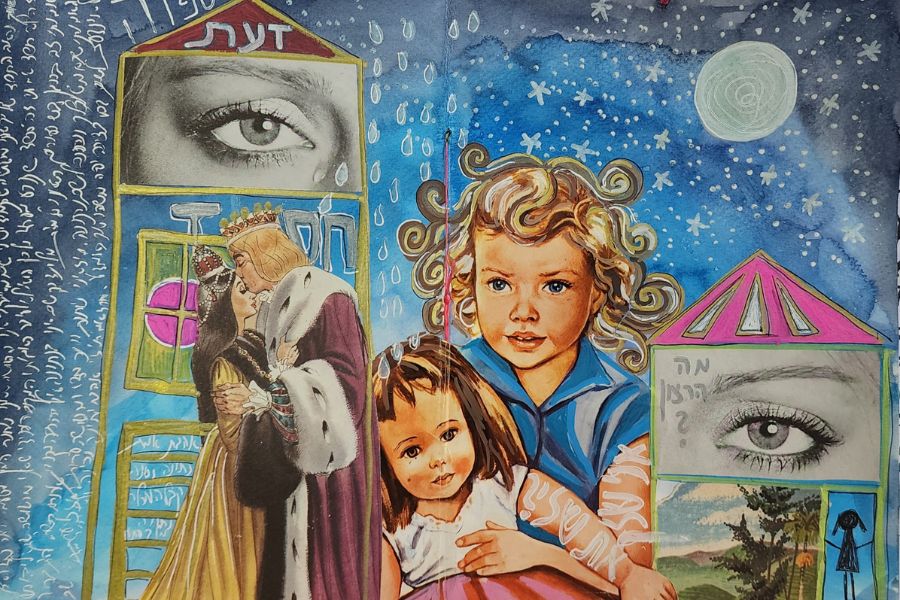
You witness it. Once a page is finished, set it upright, sit with it for a full minute without touching it, and let it look back at you. Then ask it three questions rather than explain it: what do I see, what surprises me, what does this page need from me now. Date it, close the journal, and leave the meaning to arrive in its own time.
My name is Rakefet Hadar. I am an art therapist, an author, and the founder of a school that trains facilitators in the SoulPages method of visual journaling. Almost everything written about art journaling stops at the moment the glue dries. That is strange to me, because in my own practice the page only becomes useful after it is finished. I made my first journal page in 2014, the year my mother was dying of cancer, and I remember sitting in front of it afterward with no idea what to do next. This is the part nobody taught me, so I will teach it to you.
Why is finishing the page only half the practice?
Making the page moves something. Witnessing the page is what lets you know what moved. While you are working you are inside the process, choosing colors, tearing paper, following an impulse, and you cannot see the whole while you are making it. The moment you step back, the page becomes an object outside of you, and for the first time you can meet it rather than be it. That shift, from maker to witness, is where the insight lives.
This is also the difference between art journaling as a craft and art journaling as inner work. A craft practice ends when the page looks right. An inner practice ends when the page has been seen.
How do you witness your own page, step by step?
- Set it up where you can see it. Prop the journal upright, lean it against a wall, put it on the floor and step back. Distance matters; a page held in your lap is still an extension of your hands.
- Stay for sixty seconds without touching anything. Do not fix, do not add, do not photograph. The urge to improve it is the fastest way to stop looking at it.
- Describe before you interpret. Say out loud, or write in the margin, only what is literally there: a large dark shape on the left, a small figure near the bottom edge, three strips of torn red paper. Description keeps you honest. Interpretation too early becomes a story you already knew.
- Notice what surprises you. There is almost always one element you did not plan: a color you never use, an empty corner you left alone, something placed off-center. Surprise is the page’s own contribution, and it is usually the most important thing on it.
- Ask what it needs, not what it means. More space, a second page, a word, a border, or simply to be left alone. The page often asks for something concrete before it offers anything abstract.
- Date it and close the journal. Write the date in a corner. Then close the book. Closing is a real gesture, not housekeeping; it tells your system that the visit is over.
What questions do you ask a finished page?
Keep the list short and use the same questions each time, so that over months you can hear how the answers change:
- What do I actually see here, before I explain anything?
- What is the first thing my eye goes to, and what did I almost miss?
- What surprises me?
- Where is the energy on this page, and where is it empty?
- If this page could say one sentence to me, what would it be?
- What does it need from me now?
Write the answers somewhere: the back of the page, a margin, a note on your phone. Six months from now the answers will be more useful than the page.
Why shouldn’t you interpret a page too quickly?
Because interpretation closes what the image opened. An image works precisely because it holds more than one meaning at once, and the moment you name it (“this is my anxiety”) you trade all of that richness for a label you already had words for. Nothing new can arrive after that.
This is also why, in SoulPages groups, we never interpret another woman’s page. A facilitator trained in the method creates alongside the participant rather than standing outside as an interpreter, and when a page is shared, the group witnesses it and reflects what they see, not what they think it means. Having your page received without being decoded is, for many women, the first time that has ever happened to them.
The same courtesy applies to your own pages. Witness first. Meaning, if it wants to come, will come.
What do you physically do with the pages?
| The question | What works | What to avoid |
|---|---|---|
| Keep or throw away? | Keep everything, even the pages you dislike | Tearing out a page in the mood that made it |
| Show anyone? | Only if you want to, and only to someone who will not interpret it | Posting it for approval before you have witnessed it yourself |
| Where to store? | One bound journal, in order, dated | Loose sheets in a drawer, undated |
| Come back to it? | Revisit in batches every few months | Re-reading anxiously the next morning |
| Photograph it? | After the witnessing, if you want a record | During, as a substitute for looking |
The pages you want to throw away are the ones worth keeping most often. A page that embarrasses you is usually a page that got close to something.
When should you go back and look at old pages?
Every few months, and always in batches rather than one at a time. Lay out ten or twenty pages together and look for what repeats: a color that keeps returning, a shape you draw without deciding to, an edge you never cross. A single page shows you a day. A stack shows you a pattern, and the pattern is the thing you cannot see from the inside of your own life.
Choose a calm moment for this, not a low one. And if a page brings back something heavy that does not settle, close the journal and read my guide on journaling about trauma safely, which covers pacing, closing rituals, and when to bring this work to a therapist.
Frequently asked questions
What do you do with art journal pages after you finish them?
Witness them. Prop the page up, look at it for a minute without touching it, describe what is literally there, notice what surprises you, ask what it needs, then date it and close the journal.
Should I analyze or interpret my art journal pages?
Describe first, interpret rarely. Naming a page (“this is my grief”) closes the image down to a label you already had. Witnessing keeps it open, and any meaning that matters usually arrives later on its own.
Should I keep art journal pages I don’t like?
Yes. Pages that embarrass you are often the ones that got closest to something real, and you cannot judge that in the mood that made them. Keep everything, dated and in order.
How often should I look back at old journal pages?
Every few months, and in batches of ten or twenty at once. A single page shows you one day; a stack reveals the repeating colors, shapes, and edges that are invisible from inside your own life.
Is it okay to share my art journal pages with other people?
Only by choice, and best with someone who will witness rather than interpret. In SoulPages groups we reflect what we see on another woman’s page, never what we think it means.
What if I look at the page and feel nothing?
That is a legitimate result, not a failure. Write “nothing today” next to the date and move on. Pages frequently open months later, and a blank response now says more about timing than about the page.
There is a particular quiet that happens in a room full of women when the making stops and the looking begins. The noise of scissors and water jars fades, someone props her page against a chair, and she goes still… that stillness is the actual practice, and it is the part almost nobody is taught. Give yourself twenty minutes to make a page this week, and then give yourself one more minute, just one, to sit with it before you close the book. If you want a structured way in, my guide to keeping an art therapy journal walks through the first pages, and the SoulPages courses at soul-pages.com go further whenever you are ready.
With love,
Rakefet
Recent Comments