


Grief in Images: Why Drawing Reaches What Words Can’t
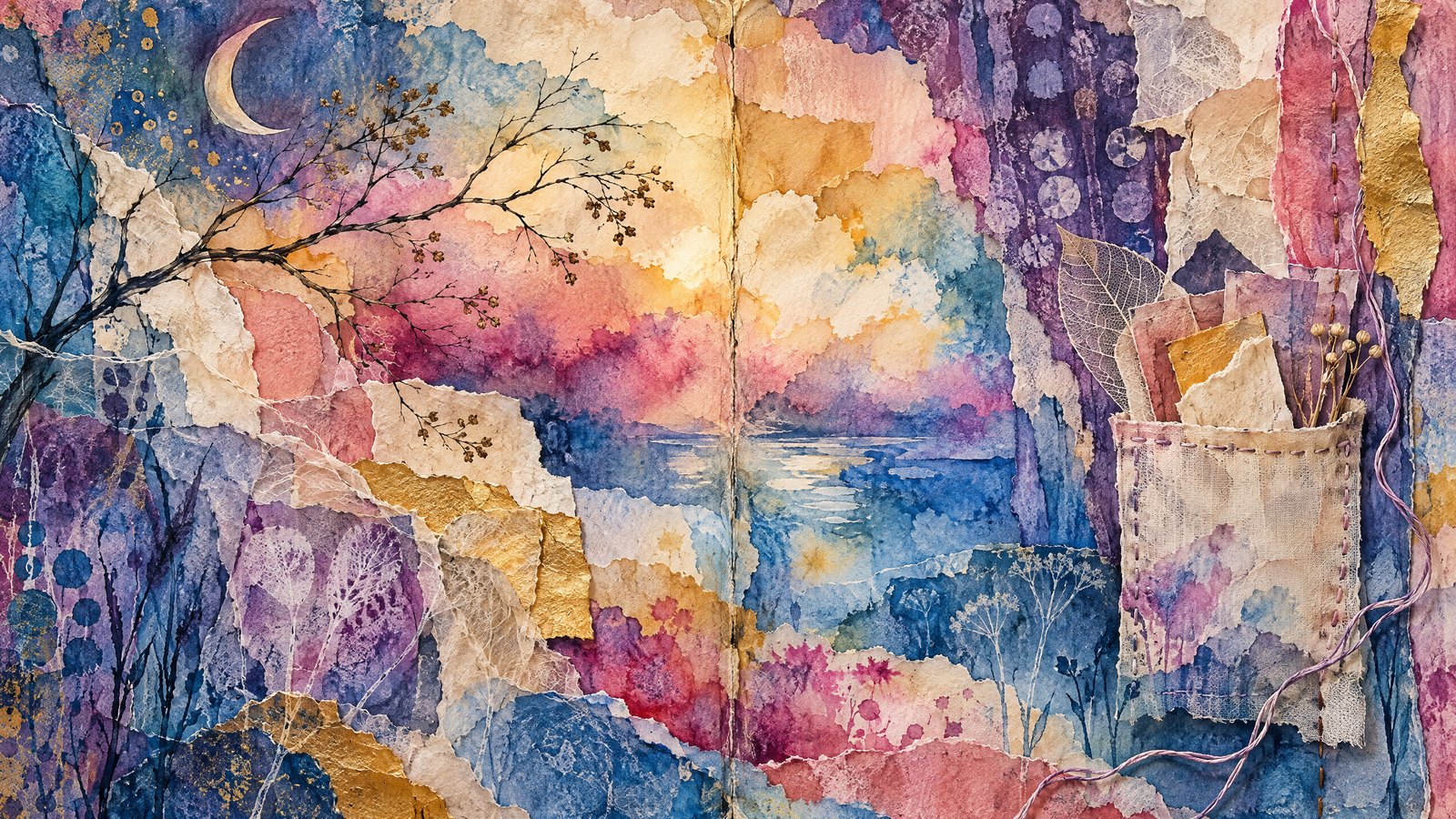
Grief rarely arrives as a sentence. It arrives as a weight, a color, an image you cannot shake, and a page lets you meet it in that form. In a visual journal you choose a color, an image or a shape, put it down without explaining it, and let the words come later, or not at all.
I am Rakefet Hadar, an art therapist, an author, and the founder of the school that trains SoulPages facilitators to guide creative work in a visual journal. I started my own visual journal in 2014, when my mother was dying of cancer. I was a therapist who gave to others all day, and I needed a place that was just mine. The method I teach now grew out of that period.
Search for art journal prompts for grief and you will mostly find lists. A list cannot tell you which prompt to skip on a bad day, or what to do when a page turns out to be too much. This article is about the page itself: why an image reaches what a sentence can’t, and how to make one, including for the kinds of grief that rarely get their own instructions.
Why does drawing reach grief when words don’t?
A sentence needs a story, with a beginning, a middle and an ending, and grief often has none of the three. A page asks for something smaller. It asks you to choose a color, to tear out one image, to draw one line. You can do that without knowing what you feel.
I once worked with women evacuated after October 7th, in a hotel lobby. One of them, who had lost her daughter, made a page. When I asked her to name it, she cried and then went silent. Words had become another wound for her. In a visual journal the order runs the other way: color and image speak first, and text arrives last, if at all. I wrote about that work in When Words Hurt.
One honest caveat. There is very little rigorous research on art journaling for grief in particular, and most of what circulates online comes from practice and from commercial blogs. What I describe here comes from my own practice as a therapist and from my own journal.
Which kinds of grief can a visual journal help with?
The same page works differently depending on what you are grieving. Four kinds come up again and again:
| Kind of grief | What makes it hard | What a page can do |
|---|---|---|
| A death | The loss is clear, and the words are not | Give the person a color, an image and a place on the page |
| Ambiguous loss: dementia, estrangement, divorce, a person who is missing | There is no ending, so the usual rituals of mourning have nothing to hold on to | Stay unfinished, with no pressure to resolve anything |
| An anniversary or a date | It arrives whether you are ready or not | A small dated page you return to each year |
| A shared loss, in a family or a community | Everyone is grieving at once, and nobody has spare words | A page made beside others, without having to tell the story aloud |
Ambiguous loss is a term from the psychologist Pauline Boss, who describes two forms: a person who is physically absent but still present in your mind, and a person who is physically present but psychologically absent. She argues that closure is a misleading goal for this kind of loss. A page suits it well, because a page is allowed to stay unfinished. Leave a corner empty. Draw a door ajar.
How do you make a grief page, step by step?
SoulPages is a method for working in a visual journal. It brings together art therapy principles, Jungian psychology and trauma-sensitive practice inside a simple structure of seven elements. Here they are, adjusted for grief.
You need a notebook with thick pages, a few magazines or printed images, scissors, glue, and whatever paints are already in the house. Twenty minutes is enough. Before you start, make sure your journal has a resource page, one built around a color you love, a place that held you, or someone who loves you. If there isn’t one yet, make that page first and come back to the grief another day.
- Intention. Choose one small direction for the page: a memory, a person, a feeling, or simply “today.” One word is enough. It only has to point somewhere.
- The magic of chance. Leaf through the images and tear out whatever you are drawn to, before you understand why. An image that seems unrelated to your loss belongs here too.
- Background. Lay down the first layer of color. It might be a color that belongs to the person, or one that feels like the weather inside you right now. Let it dry.
- Images. Glue down what you chose, or draw it. A photograph is a fine image: you can paint around it, or cover half of it. Collage is as good as drawing.
- Color. Add color where the page asks for it. Color is the energy of the page, so notice which color you reach for and which one you skip.
- Line. Line is your personal signature. Draw a frame, a thread between two images, a path, a door.
- Text. If words come, write one sentence: something you did not get to say, or just the date. If they don’t, leave it.
You do not need all seven on every page, and the order is flexible. If drawing itself is the obstacle, I wrote about that in I Can’t Draw. Can I Still Keep an Art Journal?
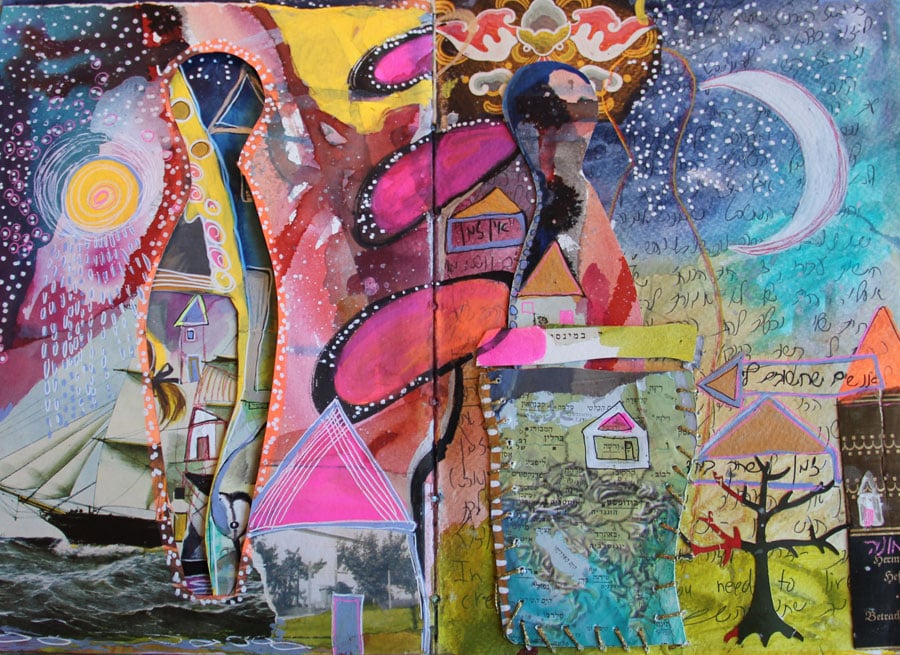
What do you do with the page afterwards?
You meet it before you explain it. In SoulPages this happens in three steps, in this order:
- Feel. What does this page do to me when I look at it, before any explanation?
- Describe. What is actually there: which colors, what is large and what is small, what sits in the corner.
- One question. An open question that does not suggest its own answer, for example: “What is the page asking me to leave room for?”
Then close the journal, write the date, place both hands on the cover and take one breath. I wrote more about looking at finished pages in What Do You Do With a Page After You Make It?
How do you get through an anniversary or a bad day?
Make the page smaller. Give yourself ten minutes and a pocket-size page: one color, one image, the date. You do not have to say everything. The date and one image are enough to mark the day.
If you make one page each year on the same date, you can lay them side by side after a few years and look: what stayed, which colors came and went, what moved. The pages are dated, so the change that felt invisible from inside any single year becomes visible across them.

When is a grief page too much, and what do you do then?
Grief is not a problem to be solved, and crying over a page is not a sign that something went wrong. But making a page can also flood you. Put the brush down, close the journal and turn to your resource page if:
- Your body goes on alert. A racing heart, short high breaths, shaking hands.
- You feel far away. A sense that you are not quite in the room.
- The same image returns again and again, with no relief.
- You feel worse after making a page, every time.
Then feel your feet on the floor, drink some cold water, and come back to the room through your senses. I wrote about this step by step in Is It Safe to Journal About Trauma? In SoulPages we start from resources, the strong and good parts of you, and we approach harder material only if you bring it in yourself.
If the grief stays unmanageable for weeks, if your sleep or daily life is affected, or if you have thoughts of hurting yourself, please do not go through this alone. A therapist can work with your pages in the room. In the US you can call or text 988, in the UK you can call Samaritans on 116 123, and elsewhere you can find a local line at findahelpline.com.
Frequently asked questions
Can art journaling help with grief?
It can. A page asks for a choice of color or image rather than a finished story. There is little rigorous research on art journaling for grief specifically, so what I can offer comes from practice: a page gives grief a form, and the words can come later or not at all.
Do you need to be able to draw to make a grief page?
No. A color wash, a torn image, a glued photograph and a single line make a complete page. The page is for you to look at. Nobody has to see it.
What should you draw when you are grieving?
Start with a color and one image, not with the loss itself. Choose the color that fits today, or an image you are drawn to without knowing why. If the person appears on the page, let them arrive in their own time.
How do you make art about a loss with no closure?
Let the page stay unfinished. Pauline Boss, who named ambiguous loss, argues that closure is a misleading goal. Leave a corner empty, draw a door ajar, and date the page so you can return to it.
How long should a grief page take?
Twenty minutes is enough for a full page. On an anniversary or a hard day, ten minutes and a pocket-size page is plenty.
What if the page makes you cry?
Crying is not a sign that something went wrong. If your body goes on alert, or you feel that you are not quite in the room, put the brush down, feel your feet on the floor and close the journal. If this keeps happening, please consider working with a therapist.
There is usually one image in the pile that you keep skipping and keep coming back to. Start there. You do not have to know yet what it means. Give yourself ten minutes today, take a page, some watercolor and a few images, and make something that reflects what you feel right now, even if you cannot name it yet. Date it, close the journal, and let it be enough for today. There is also a free lesson waiting when you join the list: soul-pages.com
If questions come up along the way, I am here.
With love,
Rakefet
Recent Comments