

What Is Active Imagination, and How Do You Practice It on Paper?
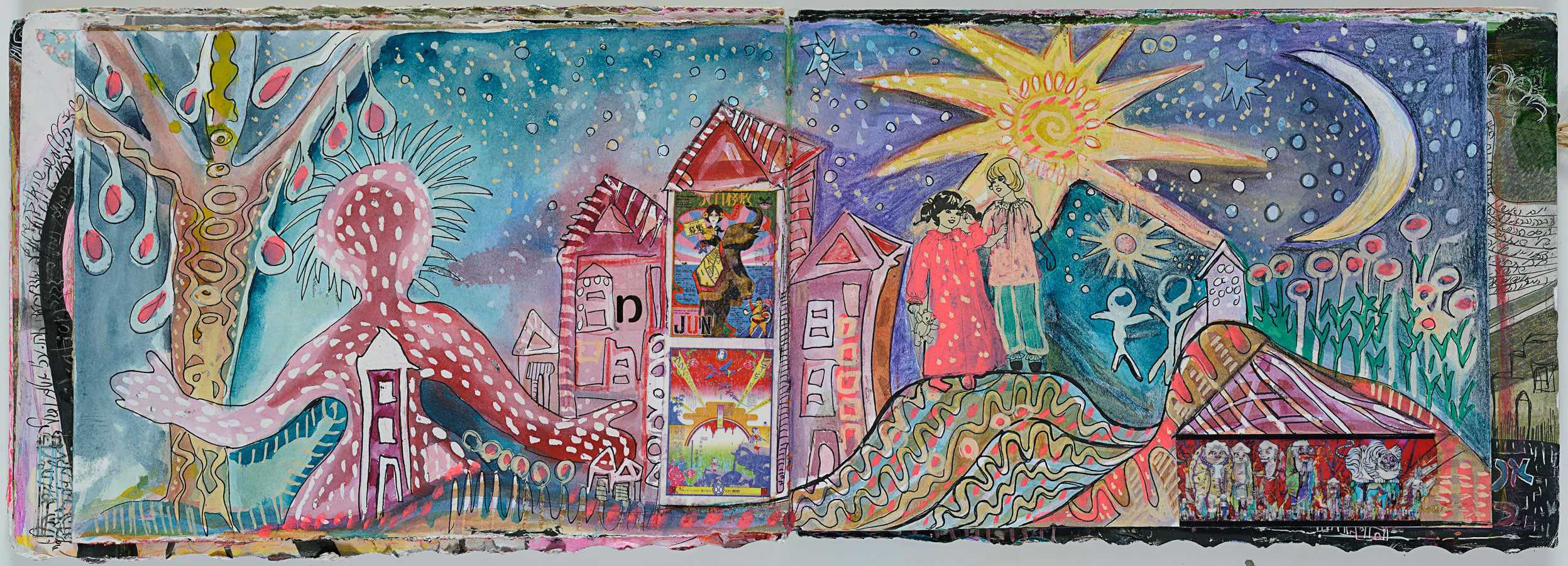
Active imagination is a method Carl Jung developed for meeting the unconscious while you are awake. You take one image, from a dream or a mood, let it move on its own, and treat whatever appears as a figure you can speak with. On paper it is simple: give the image a body in color and collage, then listen to it.
I am Rakefet Hadar, an art therapist, an author, and the founder of the school that trains SoulPages facilitators to guide creative work in a visual journal. Most of what you find about active imagination is either a Jung scholar explaining the theory, or a blog post telling you to close your eyes and have a conversation with your inner child. Neither one tells you what to actually do for the next half hour. What I want to give you here is the paper version, the one I use in my own journal, because an image that has a body on the page is much easier to stay with than one you are holding in your head.
What is active imagination?
Active imagination is a way of working with the unconscious while you are fully awake. You start from something that already arrived on its own, a dream fragment, a recurring image, a strong mood, and instead of analyzing it, you let it unfold and you watch what it does. In Mysterium Coniunctionis, Jung’s instruction was to take the unconscious in whichever form it has already offered you, give it your full attention, and observe its changes objectively.
Two things make this active imagination rather than daydreaming. You stay conscious the whole time, as the observer, and you take part: you ask, you listen, you let the figure answer back. It is a conversation, not a film you are watching.
Where does active imagination come from?
From Jung himself, between roughly 1913 and 1916, in the years after his break with Freud that he called his confrontation with the unconscious. He did not only think his way through that period. He wrote the figures down and he painted them, and those pages became The Red Book.

The best-known example of active imagination in the history of psychology was done on paper, in color, by hand. A visual journal is as close to the original as this practice gets.
A few years later, Jung kept the habit in a smaller form. In Memories, Dreams, Reflections he describes drawing a small circle in a notebook every morning in 1918 and 1919, a mandala that, as he put it, seemed to correspond to his inner situation at the time. I wrote more about that, and about what color does inside this kind of work, in Color Archetypes.
How is active imagination different from guided imagery or daydreaming?
The difference is mostly about who is steering.
| Guided imagery | Daydreaming | Active imagination | |
|---|---|---|---|
| Who chooses the images | A recording or a facilitator | Nobody, it drifts | The unconscious offers, you stay present |
| Where you are | Following someone else’s script | Half absent | Awake, watching, taking part |
| What you do with what appears | Follow it to a planned ending | Forget it | Answer it, and write it down |
| What is left afterwards | A pleasant state | Nothing | A page, and something you were told |
Guided imagery is useful, and I use visualizations in my own teaching. But there you arrive where the voice takes you. In active imagination nobody knows where it is going, including you.
How do you practice active imagination on paper, step by step?
SoulPages is a method for working in a visual journal. It brings together art therapy principles, Jungian psychology and trauma-sensitive practice inside a simple structure of seven elements. Those seven elements work well for active imagination, because they slow the whole thing down to the speed of your hands.
You need a notebook with thick pages, a pile of old magazines, scissors, glue and whatever paints are already in the house. Half an hour is enough.
Before you start, make sure your journal has a resource page in it, a page made from a color you love, a place that held you or someone who loves you. If there isn’t one yet, make that page first, and meet the figure on another day.
- Intention. Choose one image to work with: a figure from a dream, a scene that keeps returning, or the mood you woke up in. One word or one picture is enough. This is a direction, not a plan.
- The magic of chance. Leaf through the magazines and tear out every image your hand stops on, before you understand why. Do not argue with the choice. This is where the unconscious gets its first word in.
- Background. Lay down a first layer of color, the ground the figure will stand on. Choose a color that feels safe to you, because the background is your ground while you meet the figure.
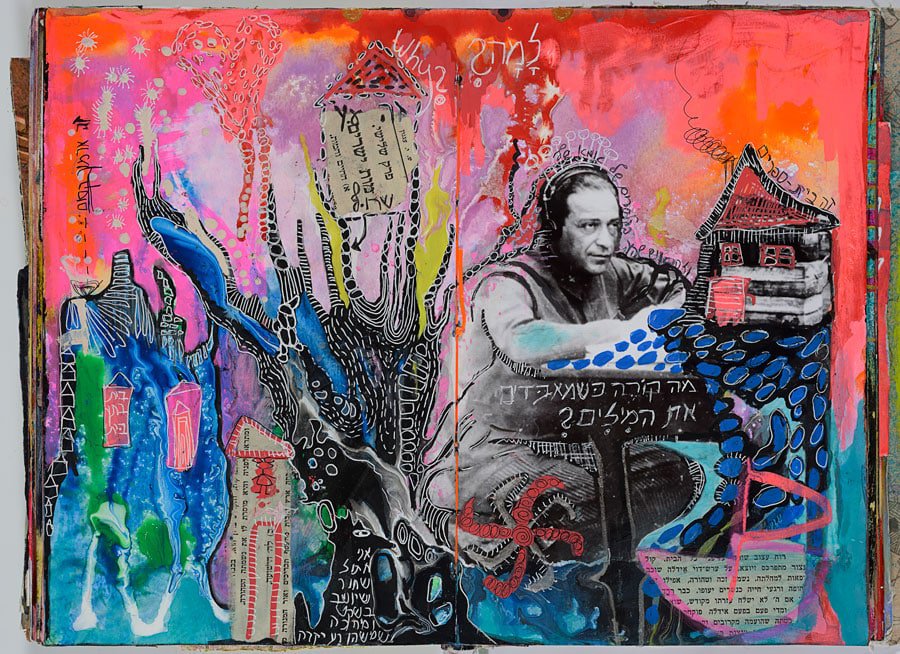
- Images. Give the figure a body: a cut silhouette, a glued face, a drawn shape, or several torn images joined together. Let it be as large as it wants to be.
- Color. Add color around it. Color is the figure’s energy, and it often says more about the figure than the image does.
- Line. Draw the line between you and the figure: a frame, a path, a thread. You decide how close it stands.
- Text. At the end, let the figure say one sentence. Write it beside the figure in its own voice, without editing it, and add the date.
You do not need all seven on every page, and the order is flexible. The structure gives you something to hold, and you are free to move inside it.

What do you do with the figure once it is on the page?
You meet it before you explain it. In SoulPages this happens in three steps, in this order:
- Feel. What does this page do to you when you look at it, before any explanation?
- Describe. What is actually there? What is large and what is small, which colors, where the figure is looking, what is hiding in the corner.
- One question. An open question that does not suggest its own answer, for example: “What does this figure know how to do that I don’t?”
Then write the dialogue. Ask the figure one real question, the kind you would be a little afraid to ask a person, and write the answer in its words rather than yours. You will recognize a true answer because it surprises you.
In Inner Work, the Jungian analyst Robert Johnson sets out four steps for active imagination: the invitation, the dialogue, the values, and the ritual. The fourth is the one people tend to skip, and in my experience it matters most: do something small and physical with what you received. Closing the journal, writing the date, placing both hands on the cover and taking one breath is a ritual. So is keeping the page where you can see it for a week. I wrote more about looking at finished pages in what to do with a page after you make it.
Is active imagination safe?
Mostly, and with limits worth naming. There is very little formal research on its safety, and the usual cautions come from clinical experience: because the process is unstructured, it can bring up intense material quickly, and anyone living with trauma, dissociation or psychosis is advised to do this work alongside a professional rather than alone.
In SoulPages we handle that by starting from resources, the strong and good parts of you, and approaching harder material only if you bring it in yourself. If the figure on the page starts to frighten you, if your heart races or your breath goes short and high, or if you feel that you are not quite in the room, put the brush down, feel your feet on the floor, close the journal and turn to a page you made from your resources, or any image that steadies you. I wrote about this in more detail in Is it safe to journal about trauma?
One more limit, a quieter one: stay the observer. If the figure starts giving you instructions about your life and you find yourself obeying them, you have stopped having a conversation. You are allowed to disagree with it.
Frequently asked questions
What is active imagination?
Active imagination is a method Carl Jung developed for engaging with the unconscious while awake. You take one image from a dream, a mood or a feeling, let it unfold on its own, and treat the figures that appear as something you can speak with and answer.
How do you practice active imagination?
Set aside a quiet thirty minutes, choose one image that already came to you, and let it develop rather than directing it. Give it a form by drawing, collage or writing, ask it a real question, write its answer in its own words, and record the date.
What is the difference between active imagination and guided imagery?
In guided imagery a recording or a facilitator chooses the images and the destination. In active imagination the images arrive on their own and nobody knows where it is going, while you stay awake and take part as yourself.
Do you have to be able to draw to do active imagination on paper?
No. Collage, torn paper, a silhouette and a field of color do the work. A figure built from magazine images with one sentence written beside it is a complete page.
Is active imagination dangerous?
It can bring up intense material, because it is unstructured. People living with trauma, dissociation or psychosis should do it with a professional. Start from your resources, set a time limit before you begin, and stop, close the journal and turn to your resource page if you cannot stay grounded.
How long does active imagination take?
Thirty minutes of making is enough for one page. The part that takes longer is afterwards: coming back to the page over the following days and seeing what it was telling you.
There is usually one image in the pile that you keep skipping, and then coming back to… that one is the door. You do not have to know yet what it means. Give yourself half an hour this week, take a page, some watercolor, a few images, and make something that reflects exactly what you feel right now. Then ask it one question, and write down what it says.
And if you want to learn the whole method, and eventually guide other women through it, that is what the SoulPages school is for.
If questions come up along the way, I am here.
With love,
Rakefet
Recent Comments