
How Does Art Journaling Help With Anxiety? What the Research Actually Says
Art journaling helps with anxiety mostly in the moment, giving your attention somewhere to land: your hands, the paper, one color. Small studies find that 20 to 45 minutes of art making can lower anxiety scores or stress hormones in students and healthy adults. The stronger trials test therapist-led art therapy, so a journal at home is support, not treatment.
I am Rakefet Hadar, an art therapist, an author, and the founder of the school that trains SoulPages facilitators to guide creative work in a visual journal. I didn’t open my first visual journal because a study told me to. It was 2014, my mother was dying of cancer, I was giving to my clients all day and coming home with nothing left, and I needed one place where I could be the one receiving. Look closely at what gets quoted online about art and anxiety, and a good deal of it turns out to be inflated or lifted out of context. So here’s the honest version: what the studies found, what they cannot tell you, why I still teach this work, and four ten-minute exercises for the moment your heart starts racing.
Does art journaling actually help with anxiety?
There is good reason to think it helps you settle, and much less evidence that it treats anxiety. Many articles blend three kinds of research into one sentence, so it is worth pulling them apart:
- One session of art making. Students or healthy adults make art once, for 20 to 45 minutes, and their anxiety or stress is measured before and after. Most of these studies find a short-term drop.
- Art therapy for anxiety. A trained art therapist works with people who live with anxiety, over a period of weeks. The trial that comes closest to a real answer found large improvements. The reviews disagree: one called the question hardly studied, and a later one counted fourteen positive trials.
- Visual journaling itself. Here the research is thinnest. The one small study I can point to saw anxiety go down, in a group too small to prove anything.
What nobody has shown yet is that a journal kept on your own, over months, treats an anxiety disorder.
How does art journaling help with anxiety?
It works through the body and the senses, which is where anxiety is loudest in the moment. Anxiety pulls your thoughts forward, toward what has not happened yet, while your hands are always in the present. Four things happen on the page:
- Your attention gets somewhere to land. When your hand spreads paint across paper, there is something to see and something to touch, and the senses bring you back to now faster than a thought can. It is hard to be completely inside a worry while your eyes and fingers are busy with wet color and the grain of the paper.
- Slow movement slows the breath. Brushstroke after brushstroke, line after line, your body gets a slow rhythm to lean on. My protocol for easing tension, Bridges to Myself, opens right there: laying down colors that feel good, slowly, while breathing deeply. I developed it in my work with women recovering from trauma.
- The worry can move outside you. On a calmer day, a worry that has been given a color and a shape is no longer circling only in your head. It lies on the page in front of you, and you can sit back and look at it from a little distance.
- Structure takes away the hardest decision. SoulPages is a method of working in a visual journal, built on seven elements: intention, the magic of chance, background, images, color, line and text. They come with a suggested order, so you do not have to decide where to begin, and in an anxious moment that is often the one decision you cannot make.
These are the mechanisms I work with as a practitioner. The studies below measure outcomes, and none of them shows which of these four is doing the work.
What do the studies show?
Here, in plain language, are the studies most often behind the claims you read about art and anxiety. Every one of them is real and worth reading. The last column is the part that usually goes missing.
| Study | Who | What they did | What they found | What it can’t tell us |
|---|---|---|---|---|
| Curry and Kasser, 2005, Art Therapy | 84 university students | 20 minutes of coloring: a mandala, a plaid pattern or a blank page | Anxiety fell about equally after the mandala and the plaid, and barely changed after the blank page | One sitting, students only, and coloring rather than journaling |
| Sandmire and colleagues, 2012, Art Therapy | 57 first-year students before exams | 30 minutes of art making, compared with a group that made no art | Anxiety in the moment fell in the art group | Whether the effect lasts, or helps an anxiety disorder |
| Kaimal and colleagues, 2016, Art Therapy | 39 healthy adults aged 18 to 59 | 45 minutes with markers, clay and collage materials, no directions | Cortisol, a stress hormone, fell overall and dropped in about three quarters of participants. Art experience made no difference | Cortisol is not anxiety, there was no comparison group, and the volunteers were healthy |
| Mercer and colleagues, 2010, The Arts in Psychotherapy | Students and staff at a medical school | Visual journaling, measured over two sessions | A general decrease in anxiety | The group was too small for the result to be statistically significant |
| Abbing and colleagues, 2019, Frontiers in Psychology | 59 women aged 18 to 65 with generalized anxiety, social anxiety or panic disorder (47 completed) | Anthroposophic art therapy led by therapists, compared with a waiting list | Large drops in anxiety and a better quality of life, still there three months later | Compared with waiting, not with another treatment, and silent on journaling alone |
| Joschko and colleagues, 2024, JAMA Network Open | 50 studies, 2,766 people, many health conditions | A review and meta-analysis of active visual art therapy | About one outcome in five favored art therapy, most showed no difference, and study quality varied widely | Not specific to anxiety, and about therapy, not a home practice |
Two reviews frame the table. In 2018, Annemarie Abbing and her colleagues searched for controlled trials of art therapy for anxiety in adults and found three randomized trials, with 162 patients between them, all at high risk of bias. Their conclusion was that the question had hardly been studied. In 2025, a review by Szymon Mizera and Krzysztof Krysta counted fourteen randomized trials with 1,686 adults, ranging from a single session of 15 to 30 minutes to programs of 5 to 12 weeks, and every one of them found less anxiety in the art group. The trials were too different from one another to pool into a single result, so the review could count them but could not say how large the effect is.
Does making art lower cortisol, and does that mean less anxiety?
It lowered cortisol in one well-known study, and lower cortisol is not the same as feeling less anxious. Girija Kaimal and her colleagues measured cortisol in the saliva of 39 healthy adults before and after 45 minutes of art making, with no instructions and an art therapist present in case anyone asked for help. Cortisol fell significantly overall and dropped in about three quarters of the participants, whether or not they had made art before.
That study is behind a headline you may have come across: making art lowers stress hormones, whatever your skill level. Before you lean on it, three things are worth knowing:
- Cortisol is a stress hormone, not a measure of anxiety. The two are related, but one does not stand in for the other.
- There was no comparison group. We cannot tell how much of the drop came from the art and how much from 45 quiet minutes at a table.
- The volunteers were healthy. Nobody was recruited because they lived with an anxiety disorder.
The researchers said much the same themselves, and called for future studies with comparison groups, clinical groups and psychological measures of stress. It is a careful small study that measured exactly what it says it measured. Nowhere does it claim that art lowers anxiety by any percentage.
Is coloring as good as art journaling for anxiety?
Nobody has compared the two directly. The closest evidence is the 2005 study by Nancy Curry and Tim Kasser, which deserves more attention than it gets: after 20 minutes of coloring, anxiety fell about equally in the students given a mandala and in those given a plain plaid pattern, and barely changed in those given a blank page.
The plaid had none of the mandala’s symbolism and did the same job. Their explanation was structure: a pattern tells your hand where to go, while a blank page asks you to decide everything yourself. It’s only one study, and it needs repeating. Still, as an art therapist, I recognized it at once. In Bridges to Myself I wrote that a blank page is the most frightening thing in the room, and that a woman who says she cannot draw is usually talking about starting, not about talent. The suggested order of the seven elements gives your hand that structure.
Whether a structured journal page calms anxiety as well as a coloring page has never been tested. What a journal adds is room for something of your own: a coloring page is finished when every shape is filled in, while a journal page can hold a color you chose, an image that stopped your hand, a word that is yours.
Is art journaling the same as art therapy for anxiety?
No, and the difference changes how you read the research. The trial that comes closest to a real answer, by Annemarie Abbing and her colleagues in 2019, worked with women diagnosed with generalized anxiety, social anxiety or panic disorder. Those who had art therapy showed large drops in anxiety compared with those on a waiting list, and the change held three months later. That is a real result about anthroposophic art therapy led by trained therapists. It says nothing yet about a journal kept alone, and nothing about how art therapy compares with other treatments for anxiety.
Art therapy is clinical work inside a relationship, and a journal at home is a different thing with a different job. I mapped the differences in my guide to art journaling vs. art therapy vs. therapeutic art.
What do popular articles get wrong about art and anxiety?
Mostly, they quote numbers without the studies behind them. These patterns come up again and again:
- A precise percentage with no study named. If an article says art journaling cuts anxiety by an exact percentage and never says who measured it, ask where the number came from.
- “75% of people felt more relaxed.” The 75% comes from the cortisol study above. It is the share of participants whose cortisol fell, and it was never a measure of how relaxed anyone felt.
- “Making art releases dopamine.” The study usually behind this line, by Kaimal and colleagues in 2017, measured blood flow in the front of the brain while 26 people colored a mandala, doodled and drew freely, three minutes each. Blood flow rose, most of all while doodling, and the researchers read that as activity in the brain’s reward pathways. Nobody measured dopamine.
- “Brain scans show that art calms the amygdala.” I know of no study that shows this for art journaling.
- Coloring studies presented as journaling studies. A study of coloring a mandala tells you about coloring a mandala.
Art can still help you. You simply deserve to know what was measured.
If the evidence is this thin, why do I still use art journaling for anxiety?
Because across students before exams, healthy volunteers and women in therapy, the small studies lean the same way, toward less anxiety or stress. The one clear exception is the blank page with no structure, and structure is exactly what a method gives you. And because it asks so little: one page, one color, ten minutes, at the kitchen table at two in the morning if that is when the anxiety comes.
So I won’t promise you that a journal treats anxiety. What it can do is give the next anxious moment somewhere to go, and leave you, page after page, a record of the moments you got through.
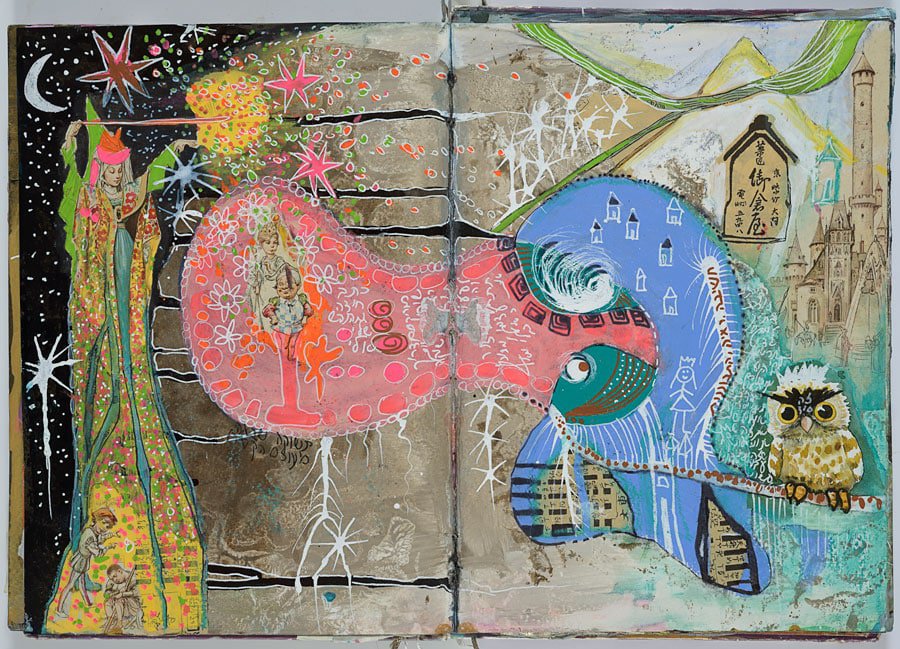

Should you draw your anxiety?
Not in the anxious moment itself. It is tempting to draw the anxiety, the knot in your chest or the storm in your head, and on a calm day that can be interesting. When your heart is already racing, drawing it brings the feeling closer at exactly the wrong time.
In SoulPages, every session begins by connecting to the strong, good parts of you and to your resources: people you love, places that feel like home, moments when you were braver than you knew. Harder material is approached only from that ground, and only if you brought it yourself. So in an anxious moment, the page turns first to what steadies you. The anxiety can wait, and if you want to meet it on a page, there will be time for that on a calmer day.
| Helps in an anxious moment | Save for a calmer day |
|---|---|
| One simple action, repeated | A complex page with many decisions |
| One or two colors you love | Hunting for exactly the right color |
| Ten minutes with a timer | Time with no end in sight |
| An image of a place that feels like home | Trying to draw what frightens you |
| Closing the journal without checking how it came out | Asking whether the page is beautiful |
What can you do in an anxious moment? Four ten-minute exercises
Get these ready on an ordinary day: a journal or a few sheets of thick paper, watercolor, a wide brush, a black pen, an old magazine and glue. Keep them where you can reach them. When the moment comes, choose one exercise only. Each one is built on one of the seven elements, and they follow the method’s order.
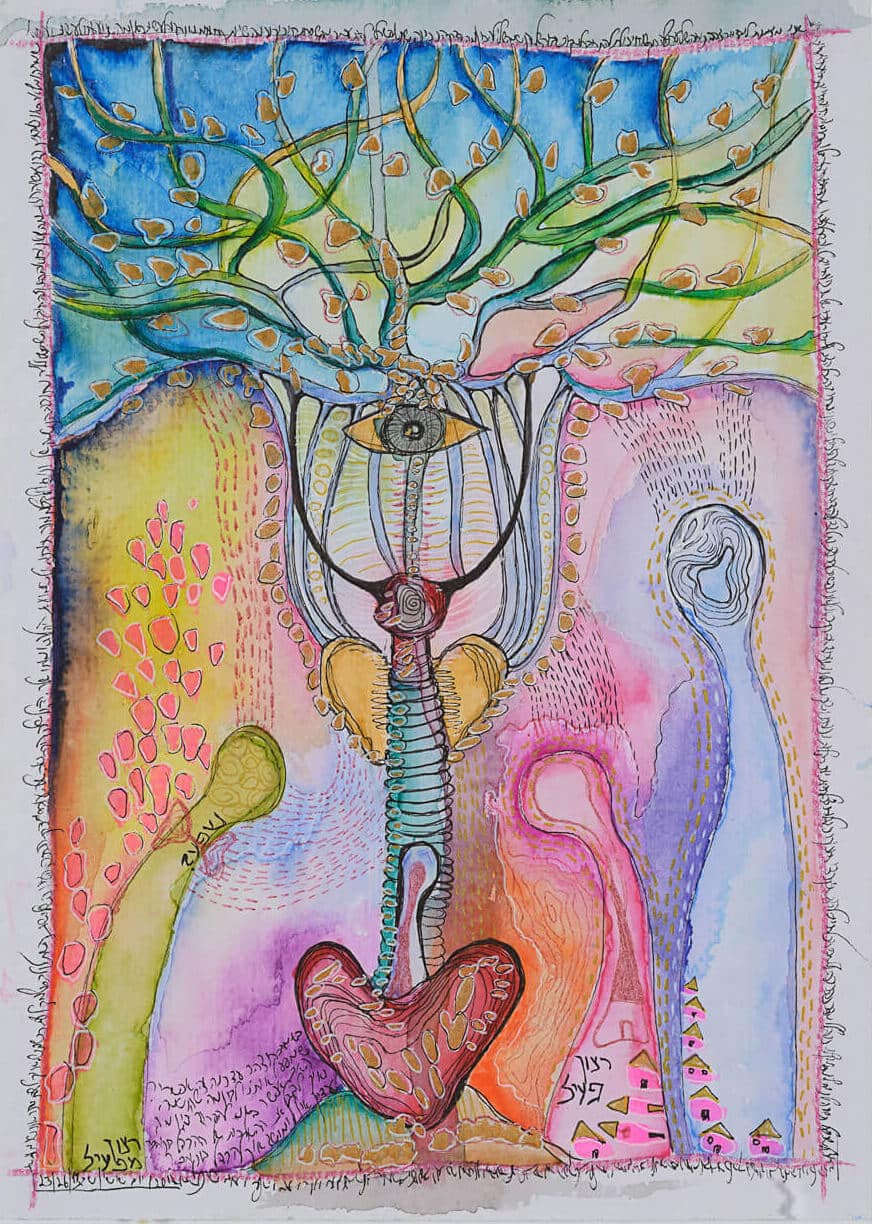
- Background: a whole page in one color. Wet the wide brush, choose a color you love and cover the entire page with it, edge to edge, in long, slow strokes. No plan and no shapes. When the page is full, put the brush down and watch the color dry.
- Images: a place that feels like home. Leaf through the magazine and stop at the first image of a place you would like to be right now: a window, a garden, the sea, a made bed. Tear it out by hand, glue it in the middle of the page and stay with it for a minute.
- Line: a line that moves with your breath. Take the pen and start a line at one side of the page. On each out-breath your hand moves forward, and on each in-breath it rests. Let the out-breath be longer than the in-breath, and keep going until the page fills with waves.
- Text: one word and a date. In a corner of the page, write one word that will be waiting for you when you come back, and add the date. Then close the journal, rest both hands on the cover and take one breath.
And if nothing comes up? Then you made a page, and that is all this moment asked of you. Right now the page is a place for your hands, and it owes you no meaning.
How long do you need to make art to feel calmer?
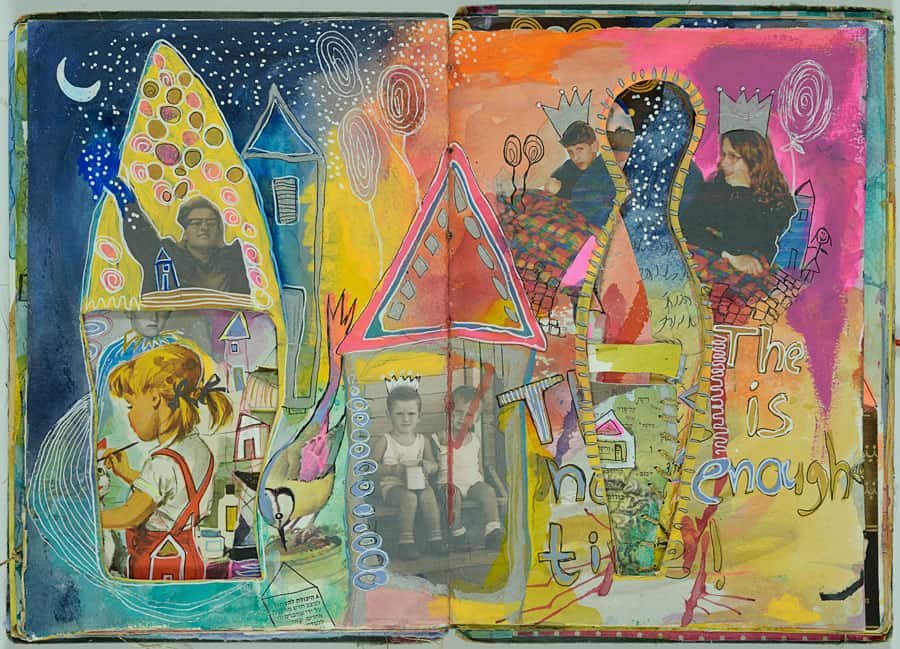
The studies used one sitting of 20, 30 or 45 minutes. In an anxious moment I suggest ten, with a timer set before you begin, because a clear end is calming in itself: you know when it will be over, and you don’t have to decide halfway through when to stop. No study I know of compares ten minutes with 45, so this is a practical suggestion, not a research finding.
On the other days, I would rather you make a small page daily, quiet days included, than one long session once a month. It becomes a habit in your hands, so that when an anxious moment comes, they already know what to do.
What if art journaling makes your anxiety worse?
Stop. It happens sometimes, especially when a page gets too close to something painful too fast. The signs are a heart racing even faster, breathing that turns shallow and quick, or a foggy feeling of being far away from the room.
- Put the brush down and move your chair back a little.
- Take three long breaths, with the out-breath longer than the in-breath.
- Name out loud five things you can see in the room, and feel your feet on the floor.
- Drink a glass of cold water, close the journal and come back to it on another day.
One hard session is not a reason to worry. If it happens every time you open the journal, it is time to work with a professional beside you. I cover pacing and stopping in more depth in my article on whether it is safe to journal about trauma.
When is art journaling not enough for anxiety?
Art journaling can calm and strengthen you, but it is not a treatment for an anxiety disorder. See a doctor or a licensed therapist when:
- Anxiety comes back almost every day, and has for several weeks.
- Your sleep, your work or your relationships are suffering.
- Anxiety comes with strong physical symptoms, such as pressure in your chest or shortness of breath.
- You avoid places or people to keep the anxiety from coming.
- You have thoughts of harming yourself. In that case, reach out for help right away: a doctor, a crisis line or someone close to you.
A journal and therapy go well together. The pages you make can come with you into the therapy room and show what is hard to say in words.
Frequently asked questions
Does art journaling help with anxiety?
Small studies suggest it can ease anxiety in the moment: single sessions of 20 to 45 minutes of art making often lowered anxiety scores or stress hormones in students and healthy adults. A journal kept alone at home has hardly been studied, so it belongs beside professional care for an anxiety disorder and cannot stand in for it.
Does making art lower cortisol?
In one study of 39 healthy adults, 45 minutes of art making lowered cortisol, a stress hormone, overall and in about three quarters of the participants. The study had no comparison group, and lower cortisol is not the same as feeling less anxious.
Is coloring as good as art journaling for anxiety?
Nobody has compared them directly. In a 2005 study of 84 students, 20 minutes of coloring a mandala or a plaid pattern reduced anxiety more than free drawing on a blank page, which barely changed it. Structure seems to matter, and SoulPages gives you structure: seven elements with a suggested order to lean on.
Do I need to be good at art for journaling to calm me?
No. The exercises that suit an anxious moment need no drawing at all: a page covered in one color you love, a line that follows your breath, an image of a calm place torn from a magazine, and one word with a date.
How long should I make art to feel calmer?
The studies used single sessions of 20 to 45 minutes. In an anxious moment, ten minutes with a timer set in advance is enough to try, and a small page on ordinary days gets your hands ready for the harder ones.
Can art journaling replace therapy for anxiety?
No. Art journaling can calm and strengthen you, but it is not a treatment for an anxiety disorder. If anxiety returns almost every day, affects your sleep, work or relationships, or comes with strong physical symptoms, see a doctor or a licensed therapist.
Anxiety doesn’t ask before it comes. It may find you in the checkout line, at two in the morning, a minute before the phone call you’ve been putting off all week. You can’t know when. What you can do is have a journal waiting on the table, with a wide brush and one color you love. Between those moments, give yourself ten minutes a day: take a page, some watercolor, a few images, and make something that reflects exactly what you feel right now. If you want the ground beneath the method, I wrote about the research behind the visual journal as a therapeutic tool, and Bridges to Myself walks you through a whole page made to ease tension. The courses at soul-pages.com are there whenever you want a structured way to continue.
With love,
Rakefet
Studies mentioned in this article
- Abbing, Ponstein, van Hooren, de Sonneville, Swaab and Baars (2018). The effectiveness of art therapy for anxiety in adults: a systematic review of randomised and non-randomised controlled trials. PLoS ONE, 13(12), e0208716.
- Abbing and colleagues (2019). The effectiveness of art therapy for anxiety in adult women: a randomized controlled trial. Frontiers in Psychology, 10, 1203.
- Curry and Kasser (2005). Can coloring mandalas reduce anxiety? Art Therapy: Journal of the American Art Therapy Association.
- Joschko, Klatte, Grabowska, Roll, Berghöfer and Willich (2024). Active visual art therapy and health outcomes: a systematic review and meta-analysis. JAMA Network Open.
- Kaimal, Ray and Muniz (2016). Reduction of cortisol levels and participants’ responses following art making. Art Therapy: Journal of the American Art Therapy Association, 33(2).
- Kaimal and colleagues (2017). [A brain-imaging (fNIRS) study of coloring, doodling and free drawing.] The Arts in Psychotherapy.
- Mercer and colleagues (2010). [A study of visual journaling with medical school students and staff.] The Arts in Psychotherapy.
- Mizera and Krysta (2025). The impact of visual art therapy on anxiety: a systematic review. Psychiatria Danubina, 37 (Suppl 1).
- Sandmire, Gorham, Rankin and Grimm (2012). The influence of art making on anxiety: a pilot study. Art Therapy: Journal of the American Art Therapy Association, 29(2), 68-73.
Recent Comments