

The Visual Journal as a Therapeutic Tool: What the Research Actually Says
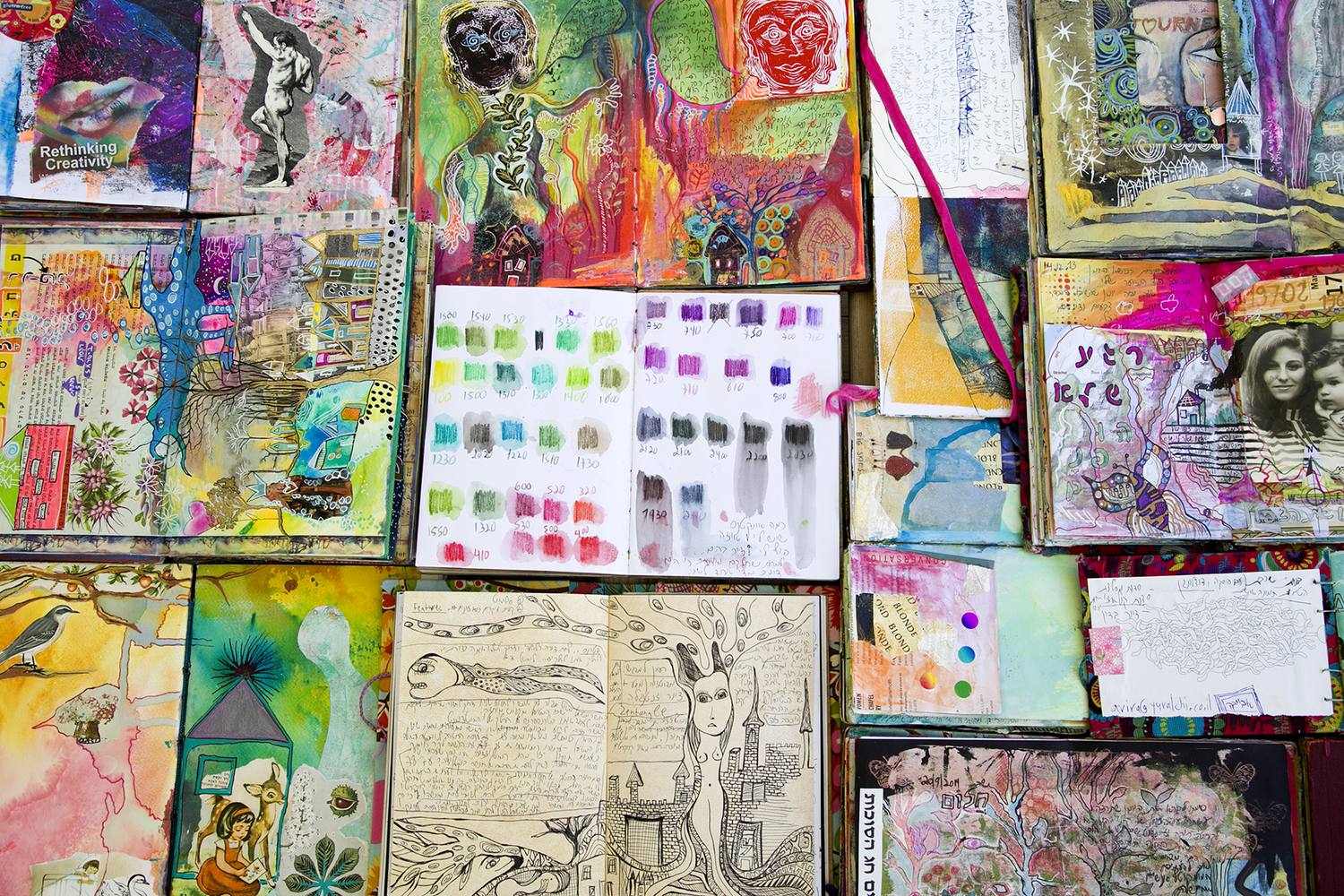
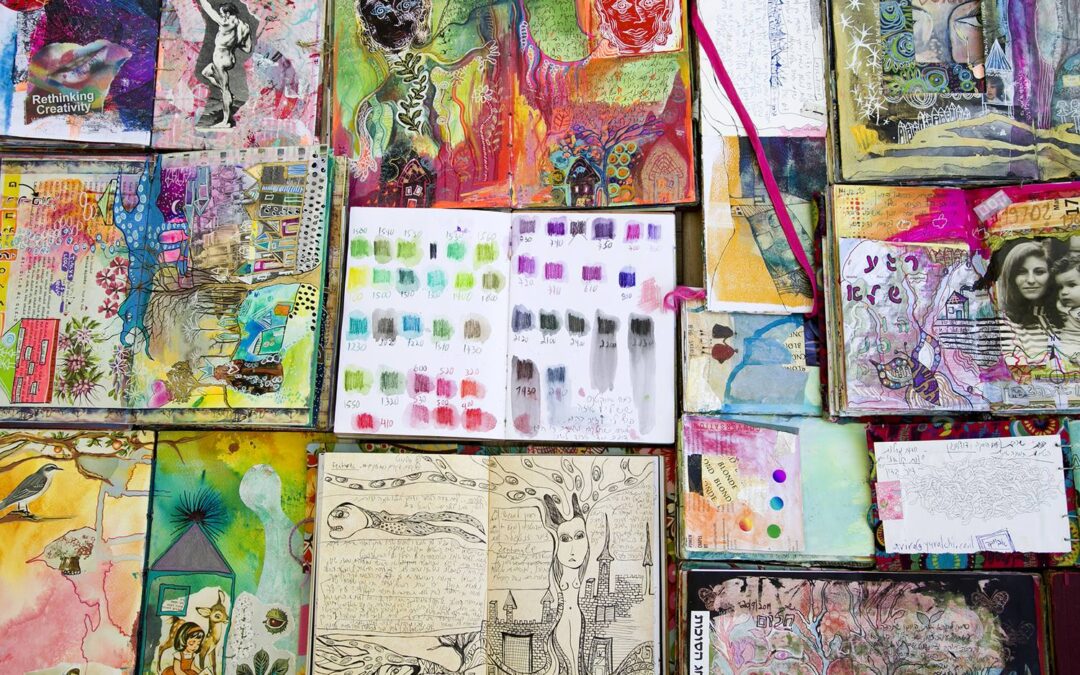
A visual journal used therapeutically is a single continuous book in which a person works in mixed media, guided by a therapist who teaches both art techniques and guided-imagery techniques. The journal gathers meaning across the whole course of therapy, becomes a transitional object the client takes home, and allows symbolic expression that never forces her to name in words what she has no words for yet.
I first set this out in an academic paper published in 2016 in Bein HaMilim (Between the Words), the peer journal of Kibbutzim College of Education in Tel Aviv, under my earlier name, Rakefet Link-Skop: Internal Journey Journaling: The Visual Journal as a Therapeutic Tool. That paper is the theoretical ground the SoulPages method grew out of, and what follows is the paper in plain English, with a link to the original at the end. The rest of the publications and press are gathered on the publications page.
My name is Rakefet Hadar. I am an art therapist, an author, and the founder of the training school for SoulPages guides. I began my own visual journal in 2014, the year my mother was dying of cancer and I was working as an art therapist who gave all day and came home in the evening with nothing left. I was looking for somewhere to be the one receiving for once, and I found it between the pages of a book I sewed myself.
How is a therapeutic visual journal different from ordinary art therapy?
The difference begins with the surface you work on. In classic art therapy the work accumulates in a box or a folder and stays in the therapy room, and towards the end of the process it is reviewed, sorted, and sometimes partly discarded. In a visual journal everything lives in one place, in the order it happened, and it travels home with the client after every session.
That looks like a technical detail, and in practice it changes three things at once:
- Narrative. Page after page builds a personal story you can turn back through, and inside it you can see movement the client herself could not feel while it was happening.
- Continuity. The work does not stop when the door closes. She carries on at home, and the bridge between what surfaced in the room and the life waiting outside it gets built on the page rather than left to memory.
- An object that remains. What is left at the end is not a scattered pile of paper but a book, and that book has weight in the hand.
In the paper I called the approach Internal Journey Journaling (IJJ), and I presented it through five foundations.
Why is the method called SoulPages today and not Internal Journey Journaling?
The name changed; the method did not. In 2016, when the paper was written, it was called Internal Journey Journaling, and that is the name used throughout it. In the years that followed, as I began training guides and taking the work beyond the therapy room, it took the name it carries now: SoulPages, and in Hebrew shitat “dapei nefesh”.
The newer name is the more accurate one, because it describes what actually gets made, a page that is a soul. Anyone who meets both names in two different places is meeting the same method and the same five foundations.
What are the five foundations of the method?
- The frame. Continuous work inside a book, usually one the client sews by hand at the start. The book is an ancient and loaded symbol, and when a woman chooses the size of the pages, the texture of the paper and the thread she binds them with, every hope she holds for the process is already inside it before a single mark is made.
- The content: parts of the psyche. Before the making there is inner work through guided imagery or dialogue with an inner part, and afterwards that material is translated into colour and image. One of the techniques I draw on is Voice Dialogue, developed by the Jungian psychologist Hal Stone and Sidra Stone, in which inner voices take on a figure you can hold an actual conversation with.
- A wide range of techniques and materials. The mixed-media language, in which a single piece is built from layers of different materials: monoprints, spattering, collage, watercolour, acrylic and simple mark-making. Those layers imitate the structure of the psyche, where there is always one layer showing through from beneath another.
- Extended session time. Fifty minutes is not enough. A session in this method runs at least an hour and a quarter to an hour and a half, because it crosses repeatedly between imagination work and making, and every crossing needs time in order to happen at all.
- The therapist’s presence, the ignition function. A therapist working this way keeps a visual journal of her own, regularly and out of genuine appetite. She is not a witness only: she demonstrates, she teaches, and at times she works beside the client on a shared page of that therapeutic hour. A therapist who does not create herself will struggle to ignite in a client the creativity that brought her through the door.
How does Winnicott’s theory explain why journaling works?
Winnicott described an in-between space where a child is neither entirely inside her own world nor entirely in external reality, a space in which the illusion holds and the capacity to play is born. That, he argued, is where creativity begins, and with it a person’s sense of being alive.
A visual journal constitutes precisely that space: real and not-real at the same time, entirely yours and also something happening between you and the person guiding you. In the paper I mapped the four stages Winnicott described in the development of play onto four stages of the therapy:
| Winnicott’s stage | What it looks like in journal therapy |
|---|---|
| Symbiosis, mother and infant as one | Therapist and client make the journal itself together: choosing paper, cover, sewing it |
| The playground, the mother allows a gradual move toward reality | Learning the mixed-media language; the therapist offers a technique at each step and gradually lets go |
| Being alone in the presence of someone | The client works in the journal on her own, including at home, with the therapist present but not directing |
| Playing together | Shared pieces, group artist books, letting another person into the work |
These stages do not run in a straight line. There is progress, and then a return to a stage where the client needs more dependence again, and that circling motion is part of the process rather than evidence of its failure.
What does Jung’s Red Book have to do with this?
Carl Jung kept several visual journals, the best known being The Red Book, in which he painted the difficult visions that plagued him and the fantasies that rose in him. He said that being able to paint those visions carried him through a period when he feared he was losing his mind, and out of that journal came his theory of archetypes and the collective unconscious, along with his development of active imagination.
When The Red Book was published in 2009 many people came to regard it as the finest example of a visual journal there is, and in its wake art therapists began drawing on the journal in trauma work. The line that runs from Jung’s book to the notebook a woman sews on her kitchen table today is exactly what the 2016 paper set out to trace.
What does it look like in practice?
The paper follows a woman I called Irena, a pseudonym, a 36-year-old mother of two who took part in a mothers’ group I led for three years. She arrived unable to show affection to her children, especially her younger son, and at the first session she told me she had not touched art materials since second grade.
Three years is a long stretch, and her movement through it matters more than any single moment in it.
In the first year the theme of the group was the child in me, and the work went towards each mother’s connection to the girl she herself had been. Irena sat beside me, asked me to decide every placement for her, and checked after each choice whether it was all right. Together we rebuilt on the page the cramped flat her family arrived at when they immigrated from Russia, the flat she was sent away from to boarding school at fourteen, and halfway through she no longer wanted to stop working.
In the second year we widened the theme to the relationship with the children in the present. In the session where the mothers were asked to meet their children in imagination and hold them, Irena could not, so I took her to another room until she could see the embrace with her eyes closed, and then she smiled and said he was holding her back. At the following session, in the journal, she glued a photograph of herself and one of her son close together but unconnected, and only after I reminded her of the embrace did she ask me to help her cut out the mother’s arms and reattach them so that they held him. Later that same year she made a figure she called the anger goblin, photographed it, showed it to her family with real pride, and around that time she also decided for the first time to come home at six in the evening, the hour her children come home.
In the third year I no longer had to lead. Her son’s behaviour and her own behaviour towards him had both changed markedly, she became the veteran mother in the group who tells the newcomers what she went through, and she worked in the journal by herself. At the last session of that year she glued a photograph of herself as a child beside a photograph of her son, side by side but not touching, asked for one piece of technical help so that they would hold hands, and finished everything else alone. At the bottom she wrote: we both had independence.
The change did not begin in conversation, and it did not happen in a single session. It began the moment the page made the embrace visible, before Irena knew how to give it at home, and from there it took another full year to become something she could do on her own.
Who is this approach for?
Both in the paper and in everything since, the answer has held: it suits adults who would never walk into art therapy by the usual door. Women for whom the word therapy is off-putting, women certain they cannot draw, and women looking for somewhere to put themselves inside a stretch of life that is hard to cross alone.
The groups that come to me include women living with cancer, with divorce, with the move into later life, with grief for parents or partners, and with the search for meaning. What they tell me is that the journal becomes a kind of companion in daily life, and that the techniques learned in a session set off work at home too, in hours when nobody is guiding them. That is the bridge the method is built for: between the therapeutic space and the life being lived outside it.
Frequently asked questions
Is visual journaling the same as art therapy?
Not necessarily. Working in a visual journal at home is a tool for self-reflection and processing, and it is not therapy. It becomes a therapeutic tool when it happens inside a professional relationship, with a therapist or trained guide who works with both the journal and imagery techniques.
What is the difference between a visual journal and a written journal?
A written journal needs words and relies on narrative order, and many people are afraid to commit their real thoughts to paper. A visual journal allows symbolic expression through colour, line and image, expression that need not be confessional and still reaches deep.
Do I need to know how to draw to keep a visual journal?
No. The mixed-media language is built on techniques that require no drawing skill at all: backgrounds, prints, spatters, collage and simple mark-making. Meaning comes from how the layers combine, not from draughtsmanship.
How long should a visual journaling session be?
At least an hour and a quarter to an hour and a half for individual work. The session contains a crossing from imagination work into making, and that crossing does not happen inside fifty minutes.
What is the difference between Internal Journey Journaling and the SoulPages method?
There is no difference; they are two names for the same method. Internal Journey Journaling is the name it was published under in the 2016 academic paper, and SoulPages is the name it has carried since, and the name guides are trained in today.
What are the theoretical sources behind the method?
Principally Winnicott, especially potential space and the transitional object; Carl Jung and The Red Book; Lucia Capacchione and The Creative Journal; Cathy Malchiodi’s writing on visual journaling in trauma work; and the Voice Dialogue method of Hal and Sidra Stone.
Where was the original paper published, and can I read it?
It was published in 2016 in Bein HaMilim (Between the Words), the journal of Kibbutzim College of Education in Tel Aviv, issue 11, under the name Rakefet Link-Skop. It is freely available on the college’s website, in Hebrew.
Ten years have passed since that paper was written. The method has a name now, a school that trains guides, and hundreds of women working in it, and its foundations have not moved: one book, layers of material, enough time, and someone making alongside you. Give yourself twenty minutes today, take a page, some watercolour, a few images, and make something that reflects exactly what you are feeling right now. If you are still deciding what you need, this piece on art journaling versus art therapy lays it out, and there is a free lesson waiting when you join the list: soul-pages.com
Read the full academic paper: Rakefet Link-Skop, “Internal Journey Journaling”: The Visual Journal as a Therapeutic Tool, Bein HaMilim, issue 11, Kibbutzim College of Education, 2016 (Hebrew)
With love, Rakefet
Recent Comments