

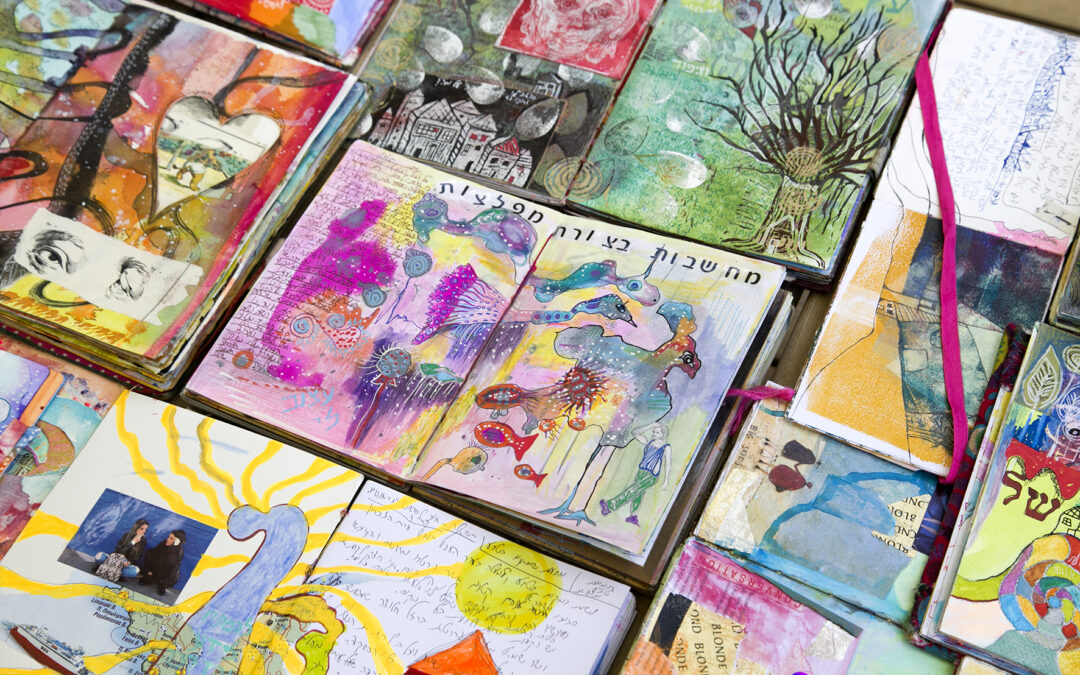
How to Facilitate an Art Journaling Group: An Art Therapist’s Guide
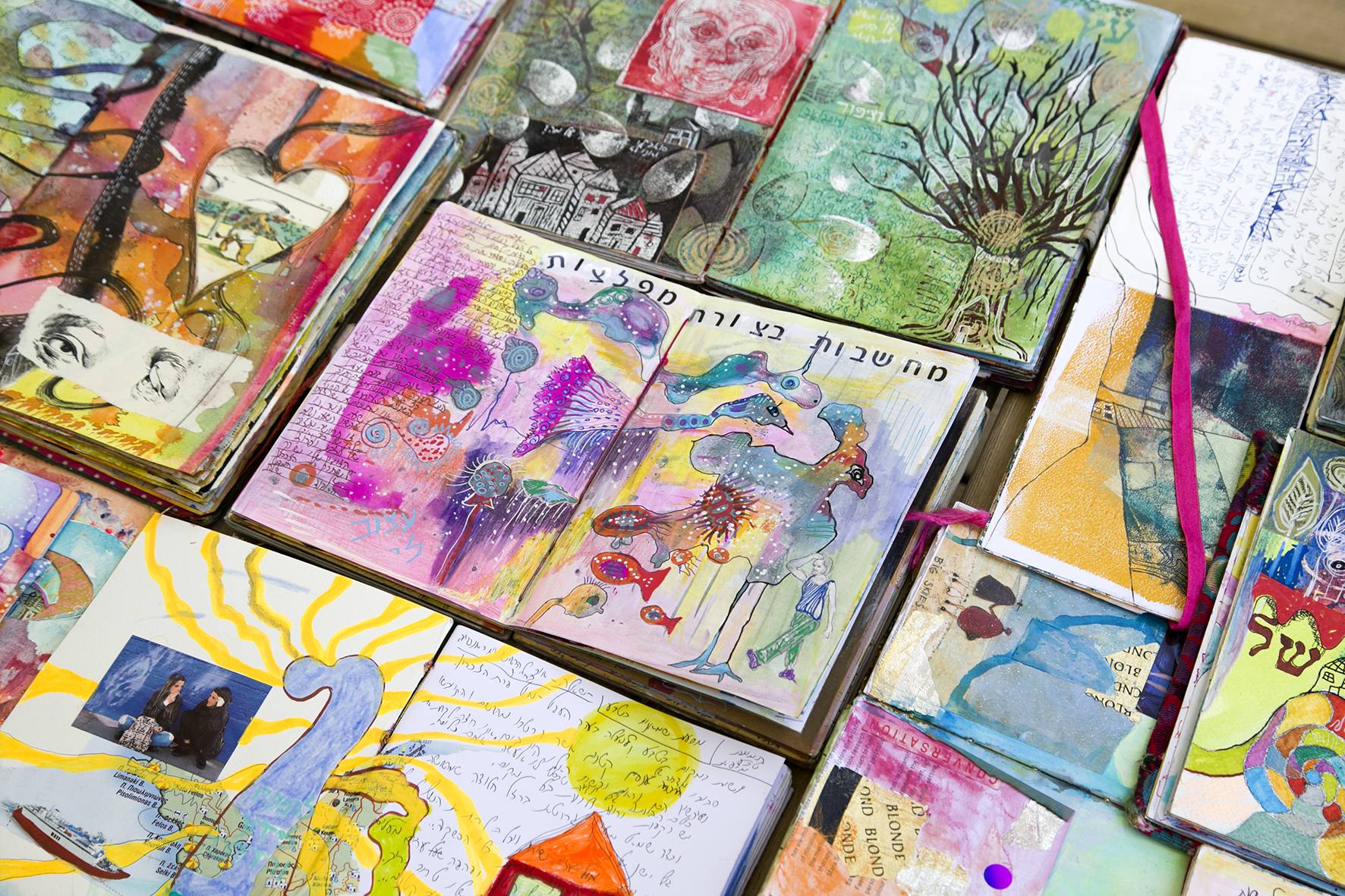
To facilitate an art journaling group, give every session a clear arc: connect each woman to a resource, build one page in layers, stop to look, and close the page with a small ritual. Make art beside the women, respond to each page by describing what you see rather than interpreting it, and know where accompaniment ends and therapy begins.
I am Rakefet Hadar, an art therapist, an author, and the founder of the school that trains SoulPages facilitators to guide creative work in a visual journal. The first facilitator training, in Hebrew, opened in 2016 because women who had journaled with me wanted to bring the method to other women, and asked me for a proper structure to learn how. The international training in English followed in 2021.
Search for how to run an art journaling group and you will find advice about venues, name tags and prompt lists. Very little of it tells you what to say when a woman holds up her page, or what to do when she goes quiet and pale halfway through the session. Those moments are the real work of facilitating, and they are what this article is about.
The SoulPages method is a way of working in a visual journal in which every page is built in layers, following a fixed sequence of seven elements: intention, the magic of chance, background, images, color, line and text. In a group, that sequence becomes your session plan.
What does an art journaling facilitator actually do?
Facilitating an art journaling group means setting the frame and the pace of a shared creative process, and keeping it safe, so that each woman can meet her own page. Three things carry most of the weight:
- You make art too. A facilitator who never makes art herself will have a hard time getting anyone else to. Keep a journal of your own, show it, demonstrate on your own pages, and work beside the women rather than standing in front of them.
- You set the frame. A personal journal for every woman, a fixed day and time, materials prepared before anyone arrives. I learned how much this matters while working with women recovering from trauma, at a time when very little in their lives stayed the same from one week to the next. Our sessions, on the same two days every week, were among the few things that stayed fixed.
- You look for the light. Part of the job is to notice what is alive and strong on a page and name it, sometimes before the woman herself can see it.
The group carries part of the work as well. In the SoulPages method, community is a resource in its own right, and what one woman dares to put on paper opens a door for the others.
How do you structure an art journaling session?
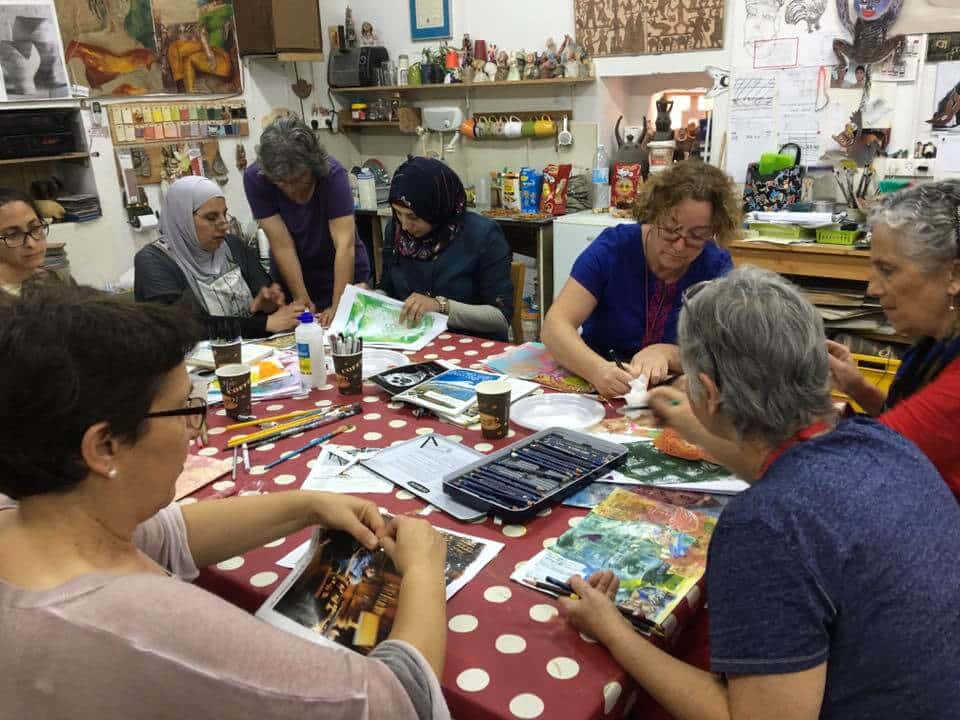
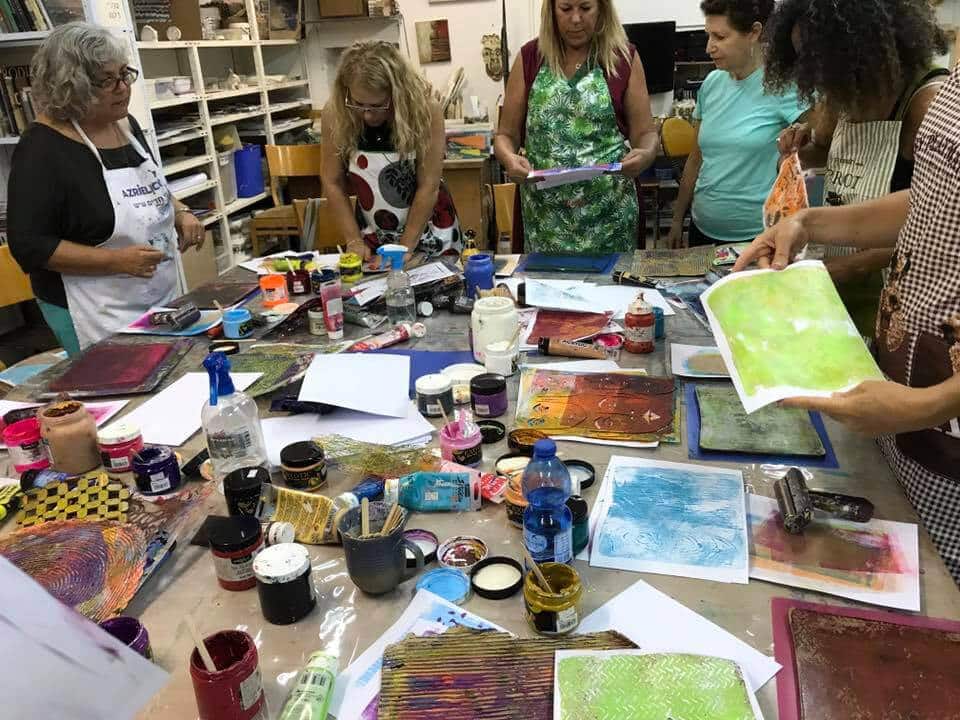
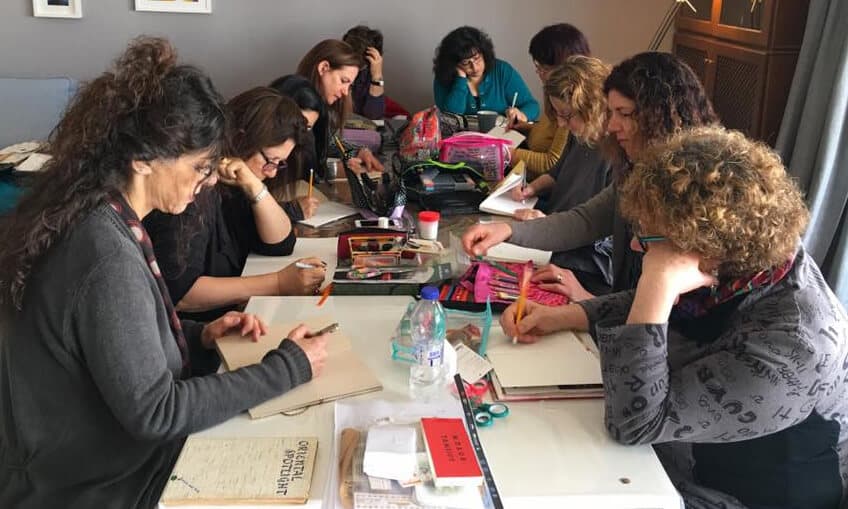
A SoulPages group session usually runs two to three hours, longer than the page alone needs. The extra time is part of the method: women talk while their hands are busy, and out of that conversation a group becomes a community. Here is the arc, step by step:
- Name the session. I give real thought to what each session is called, because the name is the first thing a woman hears and it tells her what she is walking into. Names like the Tree of Resources, Landscapes of Hope or the Inner House point toward strength before anyone picks up a brush.
- Open with a resource. Begin by connecting each woman to the strong, good parts of herself and to her resources: people she loves, places that held her, moments she was braver than she knew. The pain is in the room, and everyone knows it is there. It just isn’t the door you walk in through.
- Build one page through the seven elements. A blank page is often the most frightening thing in the room. A suggested order takes the question of where to begin off the table and leaves each woman free to give her attention to what she is making, and she can always move between the elements in her own way.
- Make art alongside them. Work on a page of your own, move around the table, and when someone is stuck, offer her a material to try. Then let her decide what to do with it.
- Stop making and start looking. Ask each woman to prop her page upright and look at it for a full minute without touching it. The noise of scissors and water jars fades, and the room goes still.
- Share by choice. Each woman decides what she shows and what she says: the process, one part of the page, or the whole of it. She can also choose one figure on the page and speak as that figure, in the first person. If time is short, sharing in pairs is better than a rushed circle.
- Close the page with a ritual. Date the page, close the journal, and rest both hands on the cover for a breath. The ritual tells the body that the visit is over. Then give the room a few ordinary minutes before the women go back to their day.
Here is what you offer the group at each layer of the page:
| Element | What you offer the group |
|---|---|
| Intention | One word or one sentence she brings to the page. Sometimes it only reveals itself halfway through the making, and that is fine. |
| The magic of chance | Techniques whose results nobody controls, such as a print or a spatter, and permission to pick the image or color she is drawn to before she understands why. |
| Background | The first physical layer on the page: a wash of color, a texture, whatever arrives. Never start with “open your journal and draw.” |
| Images | Cut, glued or drawn. Collage counts exactly as much as drawing, and cutting from a magazine leaves her the part that matters, which is the choosing. |
| Color | The energy of the page. Color often says the thing that does not have a name yet. |
| Line | Her personal signature. A line connects the parts of the page, surrounds them or keeps them apart. |
| Text | Last, never first, and optional. Text clarifies the intention. Some women feel too exposed to write on the page, and that is allowed. |
How do you respond to someone’s journal page without interpreting it?
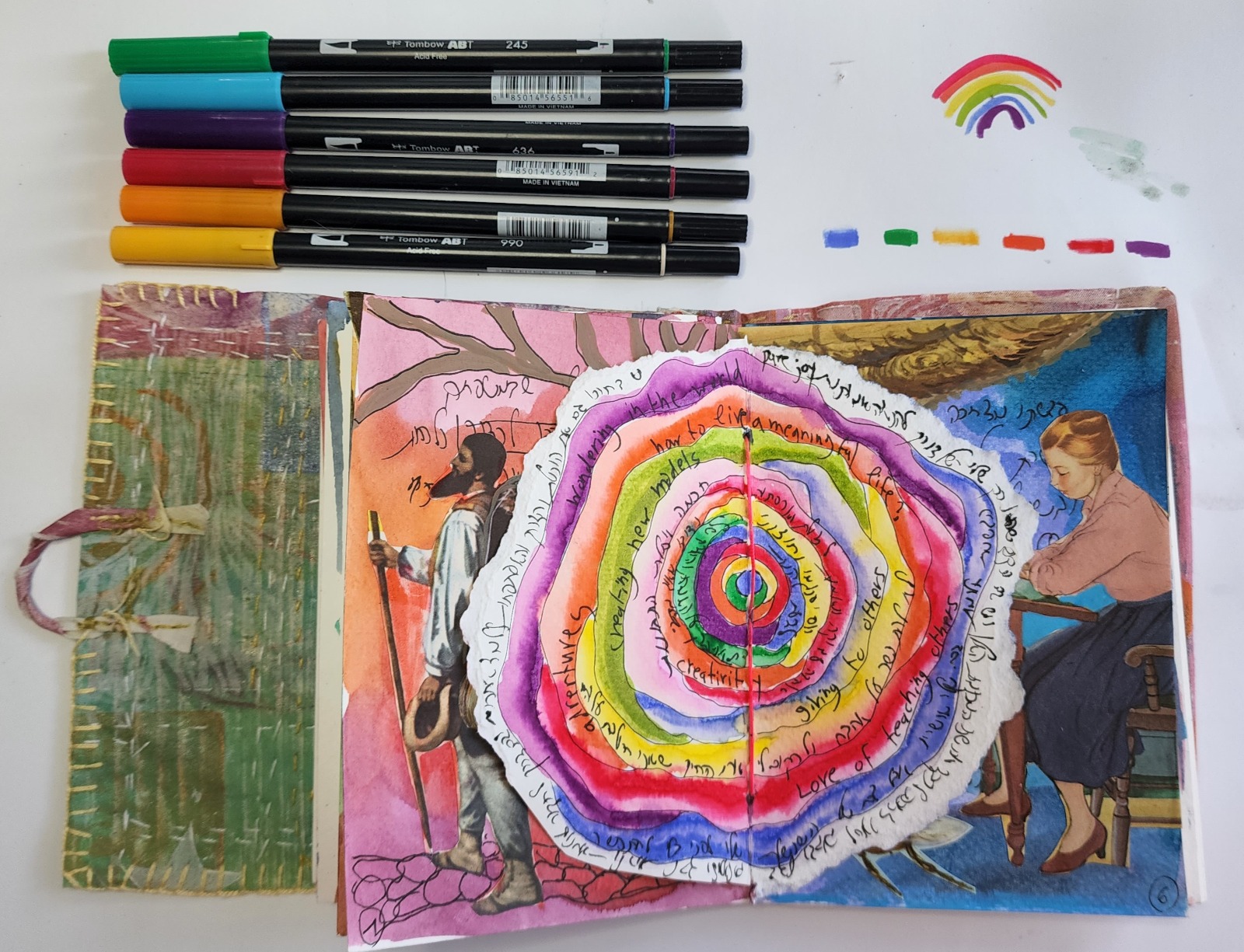
Describe before anything else. Say only what is literally on the page, ask one open question, and then stop. In SoulPages groups we never interpret another woman’s page. The group reflects what it sees, and for many women it is the first time their art has been received without being decoded.
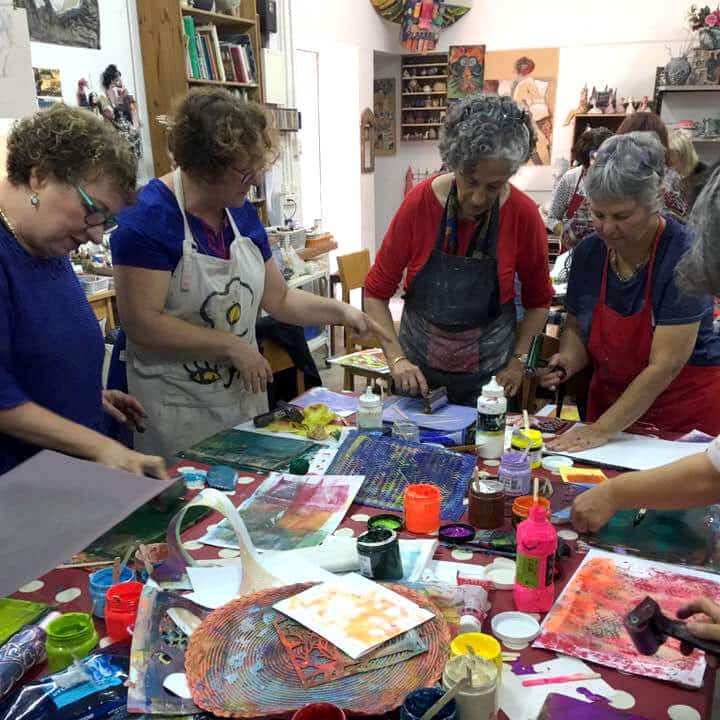
Take the spread in the photograph. A description sounds like this: a torn circle of paper glued across both pages, painted in rings of color that repeat from the center outward, words in two languages written between the rings, a man holding a hat and a walking stick on the left, a woman sitting at a desk on the right. An interpretation sounds like “you are searching for your center.” The description leaves the page open. The interpretation closes it around a label the woman never chose.
Habits that keep a response on the right side of that line:
- Let her speak first. She tells the group whatever she wants to about her page before anyone responds to it.
- Don’t grade the page. Skip words such as “beautiful” or “wow”. Praise is still a verdict, and it turns the page into a product. Say where your eye goes instead.
- Speak through the elements. The background, the color, the line: the seven elements give you a way to talk about what you see without reaching into her psyche.
- Name the magic of chance. Point to the thing nobody planned that works on the page: a color she rarely reaches for, an empty corner, a figure placed off-center.
- Ask one open question. One with no answer hidden inside it, such as “When you started with the background, what did you feel?” or “What changed on the page when you added this figure?”
- Suggest in the first person. If you have an idea, make it yours: “If this were my page, I might add something warm here.” The choice stays with her.
- When she hates her page, tell her what you do see in it and which part speaks to you. The pages that embarrass a woman are often the ones that came closest to something.
When the group responds, the same rule applies to everyone: each woman speaks only about what she sees, with no interpretation, no grading and no opinion. I have written more about this way of looking in my article on what to do with a page after you’ve made it.
What do you do when someone gets overwhelmed in your group?
First, tell processing from flooding. Processing brings the pain closer at a pace she controls, and she leaves tired and a little lighter. Flooding is different. Her body goes back on alert as though the original event were happening right now, and she is shaking, or somewhere far away.
Signs to watch for across the table:
- Shallow breath, trembling hands, her face losing its color.
- A blank or foggy look, as if she has left the room.
- The same scene coming back onto the page again and again, without relief.
What to do in the moment:
- Gently stop the work. Tell her that nothing has gone wrong. There is no failure in stopping.
- Bring her back to the room. Ask her to name five things she can see, to feel her feet on the floor, to drink some water.
- Return to a resource. Turn her toward what steadies her: a color she loves, an image of a safe place, the words of someone who loves her. This is one reason every session opens with a resource. It gives her somewhere to come back to.
- Close the page with her. A border around what she made, one closing word, or the journal shut with both hands resting on the cover.
Prevention does most of this work. Never send the group straight to the hardest material. In the SoulPages method we go to trauma directly only when a woman has brought that material herself and is ready to work with it. Leave room for the pain and the uncertainty, too, not only for the light. The simplest instruction I give works on any ordinary day as well: don’t block the pain, and don’t stay only inside it. Let the pain and the light share the same page.
And know when something is more than a group can offer. One hard session is not a red flag. The same overwhelm returning every time she opens the journal is the signal that this material needs a professional beside her, and part of your job is to tell her so, kindly and clearly. My guide to journaling about trauma safely covers the signs and the closing rituals in more detail.
Do you need to be an art therapist to facilitate an art journaling group?
No, but you do need to know which of the two you are doing. Art therapy is clinical work: a credentialed therapist assesses and treats distress inside a therapeutic relationship. A group led by a facilitator is therapeutic art, guided creative work made with healing intent, with structure and a held space, and with no diagnosis, no treatment plan and no clinical contract. I have mapped all three options in my comparison of art journaling, art therapy and therapeutic art.
| As the facilitator, you carry | You leave to a therapist |
|---|---|
| The structure, pace and safety of the session | Assessment and diagnosis |
| The materials and the order of the page | Psychological interpretation of the page |
| Witnessing each page as it is | Treatment of trauma |
| Noticing flooding and grounding her in the moment | Ongoing care when the overwhelm keeps returning |
Make this just as clear when you describe your group. A facilitator who calls her group therapy is promising more than she offers. And if you are a licensed therapist yourself, your group becomes art therapy only when you run it as clinical work.
What does a facilitator training add that experience alone doesn’t?
You cannot walk another woman through a layer you have not walked yourself. That is the first thing a training in a method gives you: the whole process, lived on your own pages, before you guide anyone else through it. The second is everything that only looks simple from the outside: how to lead a group, how to respond to a page, what to do when heavy material surfaces.
The SoulPages facilitator training runs for twenty live sessions on Zoom, and every session is recorded. One whole module is called The Group, with sessions on Reflection and Processing, The Art of Group Facilitation, Dealing with Difficult Emotions and The Art of Goodbyes. In the final module you build lessons of your own, starting from an intention and from the materials and techniques you choose.
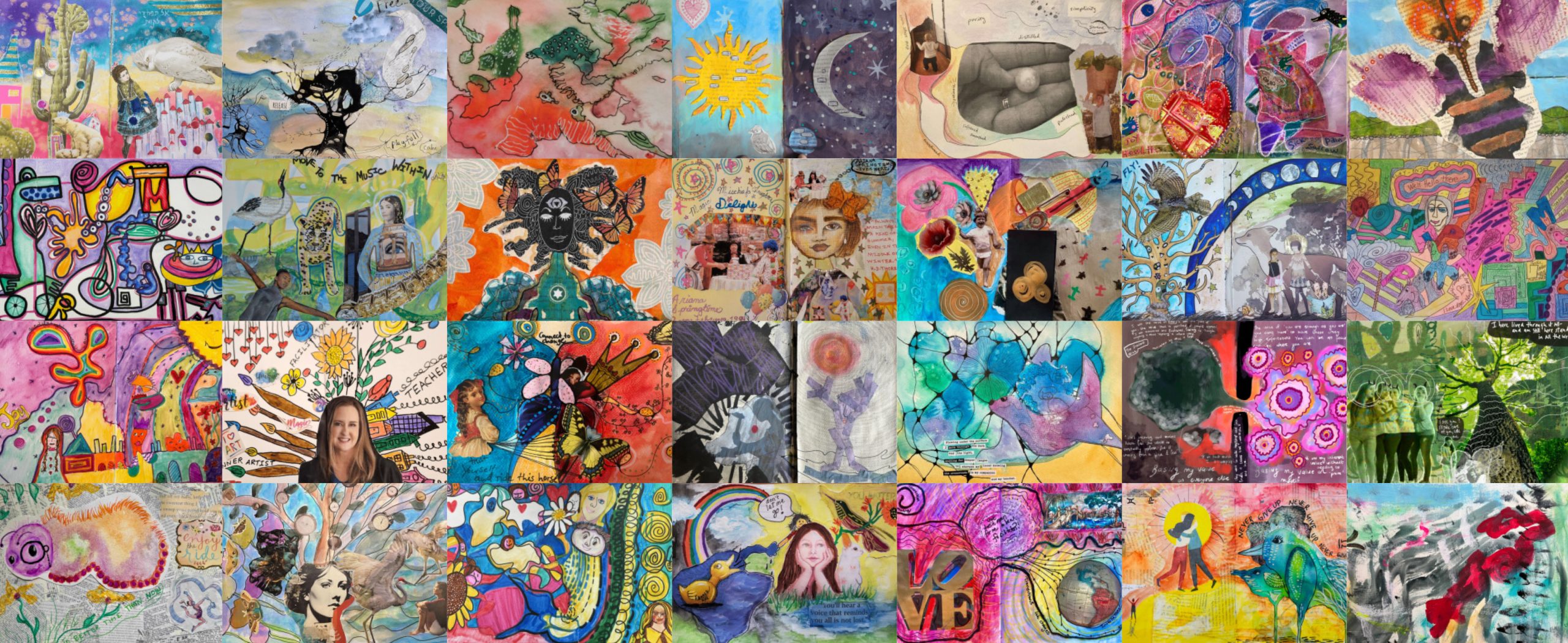
Graduates receive a SoulPages Facilitator certificate and two complete course templates, so they start teaching with a ready program rather than a blank page. The directory of certified SoulPages facilitators currently lists 35 women in 11 countries who run SoulPages groups of their own. The training is not a therapy qualification. It trains you to accompany a creative process, and the line between accompanying and treating is part of what it teaches.
Frequently asked questions
How do I start an art journaling group?
Start with your own journal, because you cannot guide a woman through a layer you have not walked yourself. Then build a frame: a personal journal for each participant, a fixed day and time, a session that opens with a resource and closes deliberately, and a clear statement that the group offers creative accompaniment, not therapy.
How long should an art journaling session be?
A SoulPages group session usually runs two to three hours. The page needs time to move through its layers, and the extra time is when women talk while their hands are busy, which is how a group becomes a community.
How do I respond to someone’s journal page without interpreting it?
Describe only what is literally on the page, name the unplanned moment that works, and ask one open question with no answer hidden inside it. Avoid verdicts such as “beautiful”, and if you have a suggestion, put it in the first person: “If this were my page, I might…”
What do I do if someone gets overwhelmed in my art journaling group?
Gently stop the work. Bring her back to the room with simple grounding: ask her to name five things she can see and to feel her feet on the floor. Then turn her toward a resource, and close the page together. If the same overwhelm returns every session, tell her this material needs a professional beside her.
Do I need to be an art therapist to run an art journaling workshop?
No. A facilitator leads therapeutic art: guided creative work with structure and a held space, but no diagnosis, no interpretation and no treatment. Art therapy is clinical work by a credentialed therapist. When you describe your group, be clear about which of the two you offer.
Is there a certification for art journaling facilitators?
For the SoulPages method, yes. The SoulPages facilitator training runs for twenty live sessions on Zoom and leads to a SoulPages Facilitator certificate, which qualifies graduates to lead groups and to work with private clients.
Something I learned about facilitating did not happen in any training room. It happened in a group of women recovering from trauma, some of whom had lost their homes. I told one of the women that I would bring her gold thread from my home the following week. She answered sadly that when I said “from my home” it hurt, because she had no home, and everything she had collected over the years was gone. That was when I understood how much care even my most ordinary words can need. The structure in this article holds the group. Your attention, down to a single phrase, holds each woman.
Before you lead your next group, give yourself twenty minutes. Take a page, some watercolor and a few images, and make something that reflects exactly what you are feeling right now. And if you want to learn to lead a group this way, the SoulPages facilitator training is where I teach it.
With love, Rakefet
Recent Comments