
When Words Hurt: Visual Journaling When There Are No Words for the Pain
When words hurt, you begin with the hands. Instead of asking a woman to tell you what happened to her, you give her a page, some colour and an image, and she puts down the thing that has no name yet. The page holds the experience whole and covered at the same time, and the word, if it comes at all, comes last and by her choice.
That is what I wrote in a chapter published in October 2024 in the anthology Safe Studio, from YAHAT, the Creative and Expressive Arts Therapies Association in Israel, under the title “When Words Hurt and Heal”: Visual Journaling with Women Evacuated from the Gaza Border Communities. The chapter is a testimony rather than a protocol, and it documents eight weeks of journaling with women evacuated to a hotel in the south of Israel. This page is its summary in English. Everything else I have published is gathered on the publications page.
My name is Rakefet Hadar. I am an art therapist, an author, and the founder of the training school for SoulPages guides. I heard about October 7th while I was in Mexico, and in the days that followed I learned that three women I knew from the Visual Journal Tribe community had been murdered in their homes that same Saturday. In early December I drove south with Maya Hod-Ran, a bibliotherapist, with no idea what was waiting for us there.
What happens when someone loses their words?
In the hotel lobby a woman sat down beside me. She had lost her daughter that Saturday. She made a page, and I asked her to give it a name. She broke into a heartbreaking cry, tried to describe what cannot be described, and then went silent.
That moment is where the chapter’s title comes from. Words, which are our ordinary way of telling someone who we are, had become another wound for her. In the visual journal the order is reversed: colour and image speak first, and text arrives last, if at all.
The SoulPages method is a way of working in a visual journal in which every page is built in layers, following a fixed sequence of seven elements, so that the word only enters after the page has already said its piece.
What is an open studio, and why is it so hard?
An open studio is a therapeutic model in which the making space is open to anyone who walks in, with no registration and no fixed group. In the evacuation centres it was open in the most literal sense: a table in a hotel lobby, and people of every age making their inner world visible without a scrap of privacy.
The first time I walked in I felt lost, as though I were being carried off by the general sense of loss around me. Neglect, mess and chaos, and around all of it a grand hotel inside which this was happening. The gap between the two was impossible to take in.
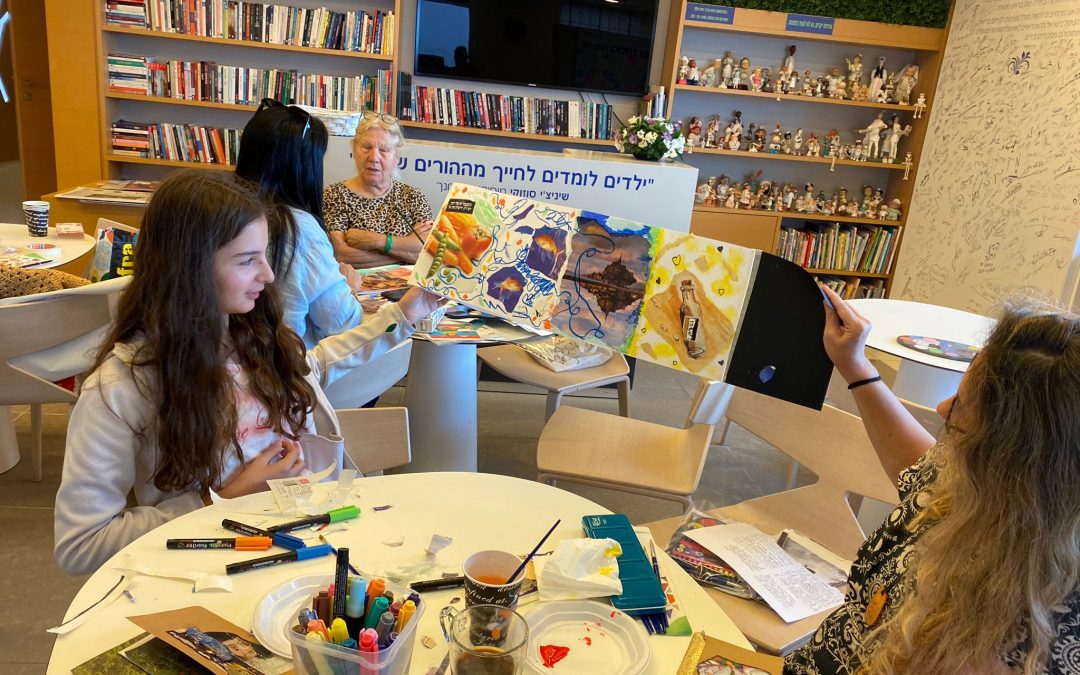
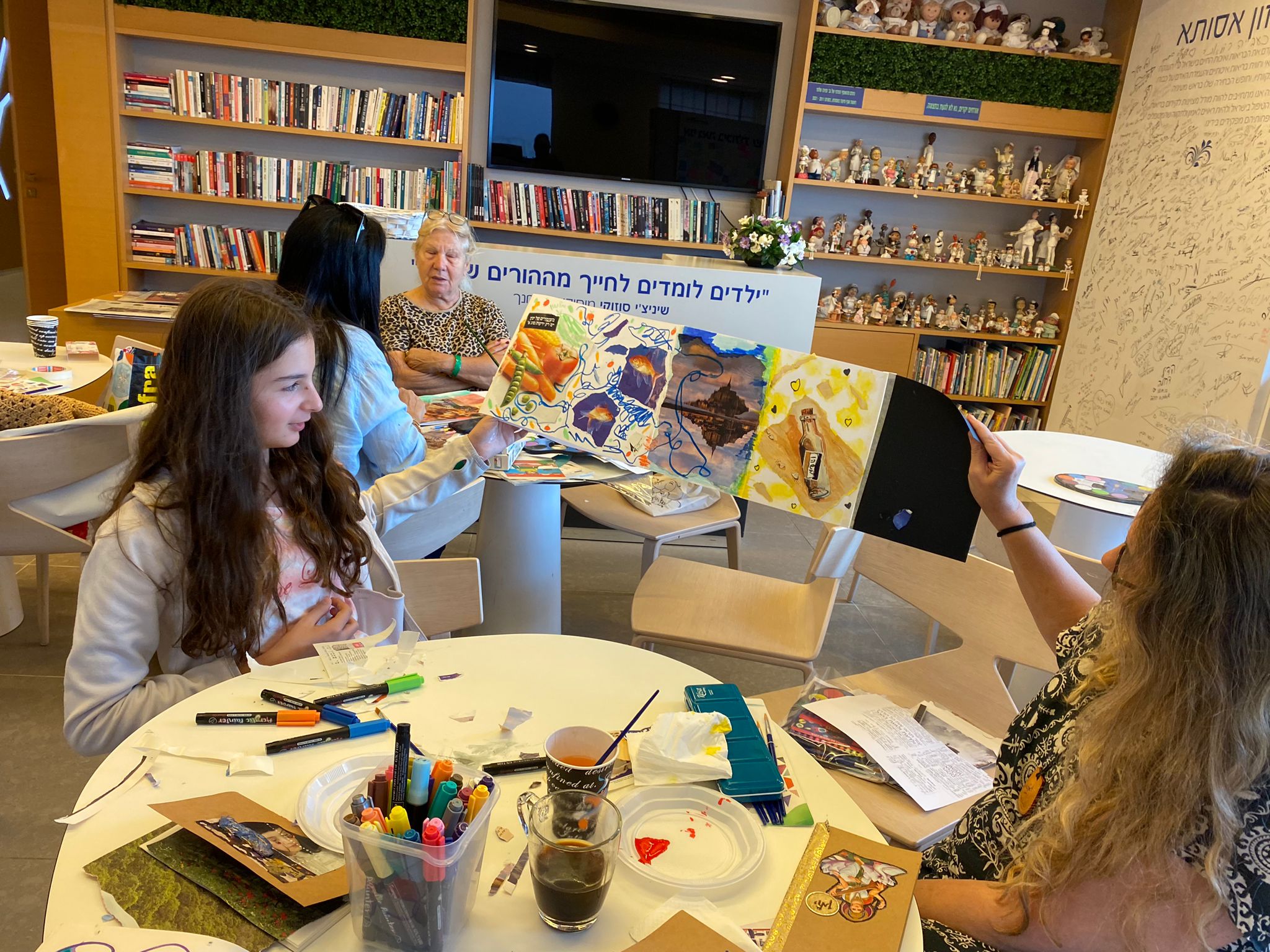
What finally worked was not an organised workshop but moving between tables. I went up to each woman who arrived, showed her my own journal, told her about the seven elements, and invited her to choose one image for what she was feeling right then. The hands began to make, and the words began to flow on their own.
How do you build a safe space when there are no walls?
Three things held the sense of safety before we ever had a room of our own:
- A personal journal for every woman. Notebooks hand-sewn in advance by dozens of volunteers. When there is no house, a sewn notebook is a place.
- The suitcase. We kept the materials in it, and it became an object that belonged to the group. Two women were put in charge of it, and it gave a small anchor to women who had lost everything they owned.
- Regularity. Two fixed days in the schedule, week after week, in a place where nothing else was fixed.
When we later moved into a closed studio, four walls made possible what the lobby could not: meditation, guided imagery and speaking out loud. The worries I had about the move turned out to be unfounded.
How do you work with pain without flooding someone?
Every week I gave real thought to what the session would be called. I chose metaphorical names that connect a woman to her strengths and to hope, the Tree of Resources, My Powers, Landscapes of Hope, the Inner House, because the name is the first thing she hears and it tells her what she is walking into.
At the same time I learned how important it is to leave room for the pain and the uncertainty too, not only for the light. As the group came together, the moment ripened for heavier material. In one session each woman was asked to recall a life-giving figure who stays with her, and two of them spoke about a mother who had died many years earlier and still supports them from a distance.
One session has stayed with me since. I called it Painting the Darkness. We worked with a technique in which rainbow colours are revealed from beneath a black ground, and I asked the women to write a paragraph beginning with the sentence “when I paint the darkness I will discover that…”. Fine lines of light started to appear out of a great darkness.
I also learned something there about my own language. I told one of the women I would bring her gold thread from home the following week, and she answered me sadly that when I say “from my home” it hurts, because she has no home and everything she had collected over the years had burned. I understood how much care words that are trivial to me can require.
What do you do in a week when making is impossible?
One of the hardest weeks was the one in which it was announced that hostages had been murdered in captivity. The atmosphere was unbearable, eyes gone dull, anger and disappointment, and the trauma struck all over again.
The women themselves brought the answer. They arrived holding newspapers and asked to work with the terrible headlines. I guided them to express the pain and the anger however they wished, and to add a pinch of hope to the page as well, and we worked with poems of hope we had printed in advance, each woman choosing one line she connected to.
That is the simplest instruction I have, and it holds on an ordinary day too: do not block the pain, and do not stay only inside it. Both of them on the same page.
What is left for a group after the facilitator leaves?
In the eighth and final session we made a collective visual poem, one line from each woman, out of the bags of images I had prepared for them at home. The excitement was enormous, and the sadness of parting sat right beside it.
That parting was not an ending. Together with the centre’s director I built a continuation plan: I would come back once a month for two days of workshops, and alongside that I would mentor volunteers who came weekly to run journaling sessions for the group. The hours that suddenly opened up in my days back home felt strange, and my heart stayed there.
Frequently asked questions
What do you do when there are no words for what happened?
You start from the material rather than the story. Choosing a colour and an image requires no phrasing, and it lets the experience be placed on the page without being said aloud. The text, if it comes, comes last and by the maker’s choice.
What is Safe Studio?
A project of YAHAT, the Creative and Expressive Arts Therapies Association in Israel, which ran therapeutic making spaces for refugees from Ukraine in 2021 and was reactivated when war broke out in October 2023. Some fifty such studios opened across the country.
What is the difference between an open studio and a closed group?
In an open studio the space is open to anyone who walks in, with no registration and no fixed membership, which makes it highly accessible but offers no privacy. A closed group in its own room allows meditation, guided imagery and personal sharing, none of which are possible in an open lobby.
Is it dangerous to work with newspapers and painful headlines?
Not when it is done with a facilitator and on one condition: something of hope goes onto the page alongside the pain. The women asked to work with the headlines themselves, and the instruction was to express the anger and add a pinch of light to the same spread.
Who wrote the chapter and where was it published?
Rakefet Hadar, in the anthology Safe Studio published by YAHAT in October 2024, edited by Dr Tamar Kichli-Borochovsky, Nona Orbach and Chen Jakobi. The chapter opens the section called Gathering Materials, on page 17. The anthology is in Hebrew.
Can you work this way on your own at home?
Yes, and that is exactly the intention. The sequence is fixed: intention, a background made without control, colour, image, line, and then one word. If making floods you every time you open the journal, that is the sign to work with a professional rather than alone.
I came home after eight weeks, and the sense that we were all part of one whole stayed with me. I said nothing clever there. I sat beside them, offered a material, and they added their own. Give yourself twenty minutes today, take a page, some watercolour, a few images, and make something that reflects exactly what you are feeling right now. And if something heavy comes up while you work, here is exactly what to do in that moment. There is also a free lesson waiting when you join the list: soul-pages.com
The full chapter was published in Safe Studio, an Anthology: Creative Texts in the Wake of the Iron Swords War, YAHAT, October 2024 (Hebrew), section 1, page 17.
With love, Rakefet
Recent Comments